
2023 in Review: South Korea’s Indo-Pacific Strategy
Korea has strived to bolster its image as a “global pivotal state” in both mending and fortifying relations with like-minded nations.
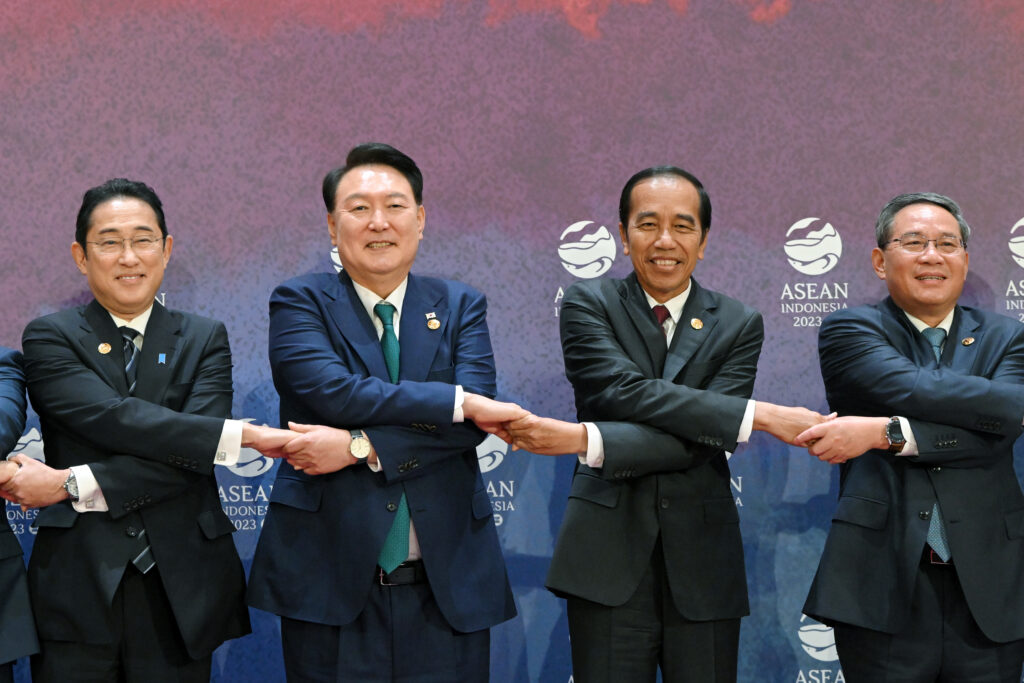
A year has passed since Korea published its “Strategy for a Free, Peaceful, and Prosperous Indo-Pacific Region” in December 2022. Since then, Korea has strived to bolster its image as a “global pivotal state” in both mending and fortifying relations with like-minded nations including the United States, Japan, the European Union, Australia, ASEAN, and others.
Korea’s Indo-Pacific strategy reflects the Yoon administration’s overarching focus on economic security and “a regional order based on norms and rules.” Notable engagements include Korea’s participation in the U.S.-led IPEF (Indo-Pacific Economic Framework), Chip 4 alliance, and cooperation with AUKUS and Quad partners on an individual basis. In addition to existing partnerships, Korea is also reaching out to a broader network of partners within the Indo-Pacific, such as the Pacific Island states. In May, for instance, Korea hosted the first Korea-Pacific Islands Summit in which the leaders committed to greater cooperation in climate and disaster resilience, capacity building, and connectivity in the post-Covid-19 era.
While Korea’s Indo-Pacific strategy signals closer alignment with the United States, it continues to pursue a cautious approach against China which is highlighted as a “key partner for achieving prosperity and peace.” The two countries have discussed potential state visits by both Xi and Yoon as well as the establishment of hotlines for supply chain communication. In the case of a confirmed state visit, it would be Xi Jinping’s first visit to Korea in nearly a decade since 2014.
Despite such developments, questions remain as to what kinds of new and/or expanded responsibilities Korea should assume as a “global pivotal state” going forward. President Yoon has emphasized Korea’s “historic mandate” of fulfilling a list of responsibilities pertaining “to the freedom, peace and prosperity of citizens around the world.” Yet details are still lacking in terms of the extent of aid and cooperation Korea is willing to provide. Will the global pivotal state’s role be limited to non-traditional security issues or extend into the collective security realm? And if so, under what circumstances?
Another key issue is President Yoon and the conservative party’s low approval rating ahead of the upcoming 2024 general election. While Yoon has emphasized his feats as a “diplomatic president,” he has faced much domestic backlash due to both the number and the cost of his overseas trips. It would help for the Yoon administration to provide a follow-up report on Korea’s Indo-Pacific strategy detailing its accomplishments and renewed commitments. Such a report would also assist the Yoon administration in contextualizing existing plans for cooperation—many of which have been drawn out over the past year—and transforming them into concrete action.
Sea Young (Sarah) Kim is a Non-Resident Fellow at the Korea Economic Institute. The views expressed here are the author’s alone.
Photo by Kang Min Seok from the Republic of Korea Flickr