
By Ellen Kim
The U.S.-Saudi Nuclear Deal Is a Test Case for South Korean Uranium Enrichment
U.S. and South Korean policymakers should develop diplomatic and institutional measures to address potential concerns and opposition surrounding nuclear-powered submarine and fuel cooperation.
Listen to this article
0:00 / 0:00
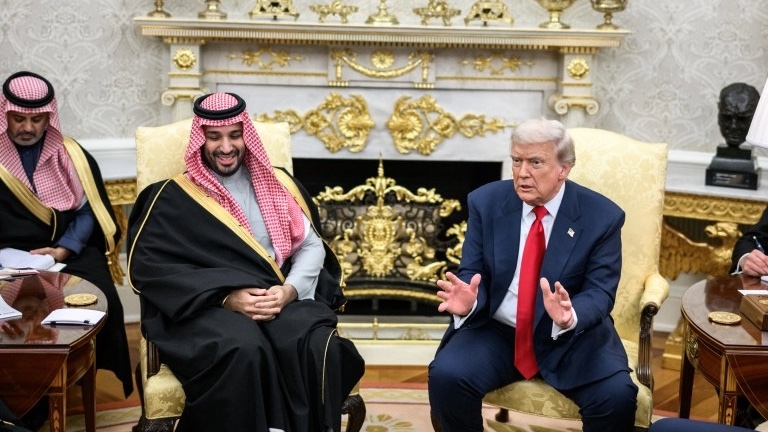
On July 22, the United States and Saudi Arabia signed a civil nuclear cooperation agreement. However, the future of the agreement became uncertain the following day when President Donald Trump made Saudi Arabia’s normalization of relations with Israel, via accession to the Abraham Accords, a final requirement for its implementation.
The U.S.-Saudi nuclear agreement has drawn considerable attention in South Korea because the U.S. administration has opened the possibility of allowing uranium enrichment on Saudi territory, contingent upon the results of a two-year joint feasibility study. During bilateral negotiations to revise the 2015 U.S.-South Korea civil nuclear cooperation agreement, South Korea sought but could not obtain U.S. advance consent to enrich or reprocess U.S. spent nuclear fuel. That situation began to change after President Trump approved a nuclear-powered submarine program for South Korea during his summit with South Korean President Lee Jae Myung last October. The two governments subsequently agreed to cooperate on options for procuring nuclear submarine fuel, and bilateral discussions on civil nuclear cooperation, including on uranium enrichment, resumed with working-level talks held in June of this year.
Against this backdrop, the future of the U.S.-Saudi nuclear cooperation agreement will serve as an important test case for future U.S.-South Korea talks. The decision to conditionally permit uranium enrichment in Saudi Arabia, even as the United States remains engaged in a conflict with Iran aimed at preventing the country from acquiring nuclear weapons, has already prompted concerns in Congress that the agreement could fuel an arms race and spur nuclear proliferation in the Middle East.
The security environment on the Korean Peninsula is not so different. While the United States and South Korea continue to pursue the denuclearization of North Korea, South Korea’s pursuit of a low-enriched uranium program to support its nuclear-powered submarine program is also likely to face criticism from those concerned about nuclear proliferation in Northeast Asia. Consequently, even if the U.S.-Saudi nuclear agreement ultimately clears congressional approval, growing concerns over nuclear proliferation in the United States and the broader international community could pose significant obstacles to advancing future U.S.-South Korea cooperation on these issues.
For this reason, U.S. and South Korean policymakers should closely examine the U.S.-Saudi nuclear agreement and develop diplomatic and institutional measures to address potential concerns and opposition surrounding nuclear-powered submarine and fuel cooperation.
First, South Korea should clearly differentiate its case from that of Saudi Arabia. Unlike Saudi Arabia, South Korea ratified and brought into force the International Atomic Energy Agency (IAEA) Additional Protocol to its Safeguards Agreement in 2004. Since then, it has accepted expanded IAEA access and short-notice inspections, strengthened the transparency of its civilian nuclear activities, and faithfully fulfilled its obligations under the international nonproliferation regime. South Korea should emphasize this strong nonproliferation record and make clear that any future uranium enrichment program for nuclear-powered submarine development would operate under the IAEA’s stringent safeguards and verification regime. In addition, Seoul should proactively propose additional enhanced safeguards and verification mechanisms to ensure that nuclear materials cannot be diverted for purposes beyond those agreed upon by Washington and Seoul.
Second, the United States and South Korea should develop a win-win strategy for civil nuclear industry cooperation. South Korea currently operates twenty-six nuclear power reactors and has emerged as a major exporter of nuclear power plants. To compete more effectively with China and Russia, whose influence in the global nuclear market continues to expand, the United States and South Korea should leverage their respective strengths to build a more competitive partnership. Given South Korea’s recent indication of energy as a priority sector for its investment projects in the United States, there is an opportunity to align these investments with expanded bilateral cooperation in the nuclear industry.
Finally, the most important prerequisite for U.S.-South Korea cooperation on nuclear-powered submarines and fuel is mutual trust. Such cooperation cannot be advanced solely through decisions by the executive branch in the United States; it will ultimately require the support and approval of Congress. However, the current U.S.-South Korea relationship faces multiple challenges spanning security, trade, and other areas. Rather than addressing nuclear cooperation in isolation, both governments should manage the alliance comprehensively and approach these issues with a long-term perspective, resolving them gradually while preserving the broader strength and credibility of the alliance.
This article was originally published in Korean in Hankook Ilbo on August 1.
Ellen Kim is Senior Fellow and Director of Academic Affairs at the Korea Economic Institute of America (KEI). The views expressed here are the author’s alone.
This material is distributed by KEI on behalf of the Korea Institute for International Economic Policy. Additional information is available at the Department of Justice, Washington, DC.