
By Tom Ramage
What May Be Driving Trump’s Latest Tariff Threat Against South Korea
Investment commitments and tariff deals with the U.S. may now have to be completed with the caveat in mind that anything can change at a moment’s notice.
Listen to this article
0:00 / 0:00
On Monday, January 26, 2026, U.S. President Donald Trump announced he would raise tariffs on South Korea, including on certain Section 232 sectors such as autos, lumber, and pharmaceuticals, from 15 percent to 25 percent. Trump cited inaction by the Korean National Assembly to codify portions of the trade deal the two countries agreed to last summer.
As of this writing, there have been no official adjustments to the U.S. tariff schedule; the higher tariffs remain just a threat. But Trump’s Truth Social post suggests a troubling path ahead for the U.S.-Korea economic relationship and the rollout of a USD 350 billion domestic investment fund meant to usher investment into the United States.
A lot of the president’s consternation with how the deal is being handled in Korea may come from the type of deal it was and the legal avenues it used. The main document was a White House joint fact sheet, while the investment fund operated—in name and practice—under a memorandum of understanding (MOU). Although the fact sheet functionally acts as the deal securing 15 percent tariffs under the International Emergency Economic Powers Act (IEEPA)—and the investment MOU sets the Section 232 auto tariffs at the same level—both differ radically from the traditional free trade agreement (FTA) method of forming bilateral deals, which has a set precedent for legislative ratification.
Accordingly, there was an apparent parliamentary split as to how the investment deal should be processed, with South Korean President Lee Jae Myung’s Democratic Party initially labeling it as a “non-binding agreement” that does not require ratification by the National Assembly, while the opposing People Power Party (PPP) called for formal legislative ratification, citing the potential negative impact such a fund could have on the Korean economy. Subsequently, on November 26, the ruling party submitted a “Special Act on Strategic Investment Management between South Korea and the United States,” which outlines the procedures for implementing the USD 350 billion investment MOU. The MOU terms, which noted that an implementation bill would be submitted to the National Assembly, stated that the 15 percent tariffs would go into effect retroactively from the first day of the month. Even though a bill has been submitted, it is now stalled in the National Assembly’s finance committee, which is chaired by a PPP representative.

President Trump’s January 26 Truth Social post announcing 25 percent tariffs.
Other developments may have informed President Trump’s thinking about tariffs against South Korea. Following a December data breach at Coupang, a Seattle-based e-commerce company, the Korean government launched an investigation into the firm, with President Lee calling for tougher penalties for dealing with “corporate negligence” in data breaches. The Korean government’s response led to public backlash in both countries over alleged country-specific discrimination, alongside questions about whether those claims are true. U.S. investors in Coupang, alleging discrimination against the company amid the investigation, subsequently asked the Trump administration to intervene, specifically calling for the Office of the U.S. Trade Representative (USTR) to impose trade remedies. The investors (Greenoaks Capital Partners and Altimeter Capital Management) subsequently filed arbitration claims against the Korean government on January 22. Along these lines, Vice President JD Vance raised the issue with Korean Prime Minister Kim Min-Seok during the latter’s visit to Washington, DC, last week, noting possible “legal issues under South Korea’s system” when discussing the ongoing dispute over Coupang. He went on to state that, “it would be preferable to manage matters so that misunderstandings do not escalate between the two governments.”
Peripherally, cross-border disputes involving U.S. technology companies and allegations of “discrimination” against U.S. firms had been a controversial aspect of U.S. economic discussions with Korea. In the lead-up to the U.S.-Korea economic negotiations last year, several dozen U.S. representatives sent a letter to the Trump administration urging it to use the negotiations to “address remaining barriers imposed by the South Korean government unfairly targeting American service providers and innovators in digital industries”—specifically targeting Korea’s online platform legislation and regulatory powers by the Korea Fair Trade Commission (KFTC).
Although the joint fact sheet subsequently included language stating that the two sides would “commit to ensure that U.S. companies are not discriminated against and do not face unnecessary barriers in terms of laws and policies concerning digital services,” the two countries left the deal without any formal commitment to address the issue. Furthermore, almost immediately after leaving his August meeting with President Lee, President Trump posted on his Truth Social account that he would impose tariffs on countries that impose digital services taxes, or otherwise “discriminate against American technology.”
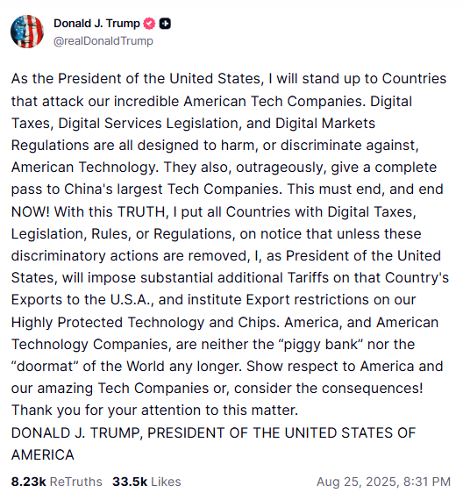
President Trump’s Truth Social post on August 25 announcing tariffs on countries that “discriminate against American Technology.”
Separately, rumors (which the Korean government subsequently denied) that Korea would hold off on transferring its first USD 20 billion installment of the investment package due to the weak exchange rate likely did not help alleviate President Trump’s frustrations with the Korean National Assembly’s delay. This, taken together with any of the other factors, could have been enough to prompt the president’s indignance, especially as the White House physically logs such investment commitments as part of a running track record of the Trump administration’s performance.
What It Means
The main takeaway is that the original “Trump Round” deal in July, taking place in record time as far as official trade negotiations go, may have failed to resolve some significant economic issues due to the priority placed on finalizing what was in effect a bilateral FTA ahead of an arbitrary summer deadline. More than anything, this may underscore the challenges facing the United States when bypassing pre-existing legal vehicles, such as the U.S.-South Korea FTA, in opening economic negotiations with partner countries.
The discussions between Washington and Seoul held in advance of and following the bilateral trade deal may only signal more of what is to come in the diplomatic and trade relationship. Investment commitments, tariff deals, and bilateral MOUs may now have to be completed with the caveat in mind that anything can change at a moment’s notice.
Tom Ramage is Economic Policy Analyst at KEI. The views expressed are the author’s alone.
Feature image from The White House.
KEI is registered under the FARA as an agent of the Korea Institute for International Economic Policy, a public corporation established by the government of the Republic of Korea. Additional information is available at the Department of Justice, Washington, D.C.