
By Arius Derr
Future of Korea: Philadelphia’s Human Capital Fueling Global Partnerships
Philadelphia and the state of Pennsylvania play an outsized role in strengthening people-to-people ties that underpin the U.S.-South Korea alliance.

The Korea Economic Institute of America (KEI) recently led a delegation to Philadelphia, Pennsylvania, to explore the city’s evolving role within the U.S.-South Korea relationship and engage with the local business, academic, and civic communities. Perhaps best known for its history, culture, and sports teams, Philadelphia is also emerging as a dynamic twenty-first-century hub for innovation, advanced manufacturing, and trade. With world-class universities across the state, a skilled workforce, and a growing network of international partnerships, the city provides a natural foundation for the United States to strengthen its relationship with key allies, including South Korea.
The visit was part of KEI’s Future of Korea (FOK) program—its longest-running and flagship public outreach initiative—conducted in partnership with the World Affairs Council of Philadelphia. The delegation included KEI’s Director of Communications Arius Derr, the U.S. Department of State’s Foreign Service Officer John Ryan, and the South Korean Embassy’s Second Secretary Yeji Lee. From September 15 to 17, the team met with local business leaders, students, policy practitioners, and community members to discuss the future of the U.S.-South Korea relationship, economic and trade developments, and security issues on the Korean Peninsula.
The delegation began its visit with a one-on-one meeting with the Chamber of Commerce for Greater Philadelphia, where they received a detailed and thoughtful overview of the city’s economic past, present, and future from Senior Director for International Business and Global Strategy Pierre-Olivier Lugez. The conversation traced Philadelphia’s evolution from a twentieth-century industrial power to its current efforts to attract high-tech manufacturing and twenty-first-century service industries. In 2025, Philadelphia is a leading life science, tech, and infrastructure hub, making it an attractive constellation for international firms seeking a foothold in the U.S. market. These advantages are compounded by the city’s proximity to a skilled talent pool and strong institutional partnerships, including several world-leading universities.
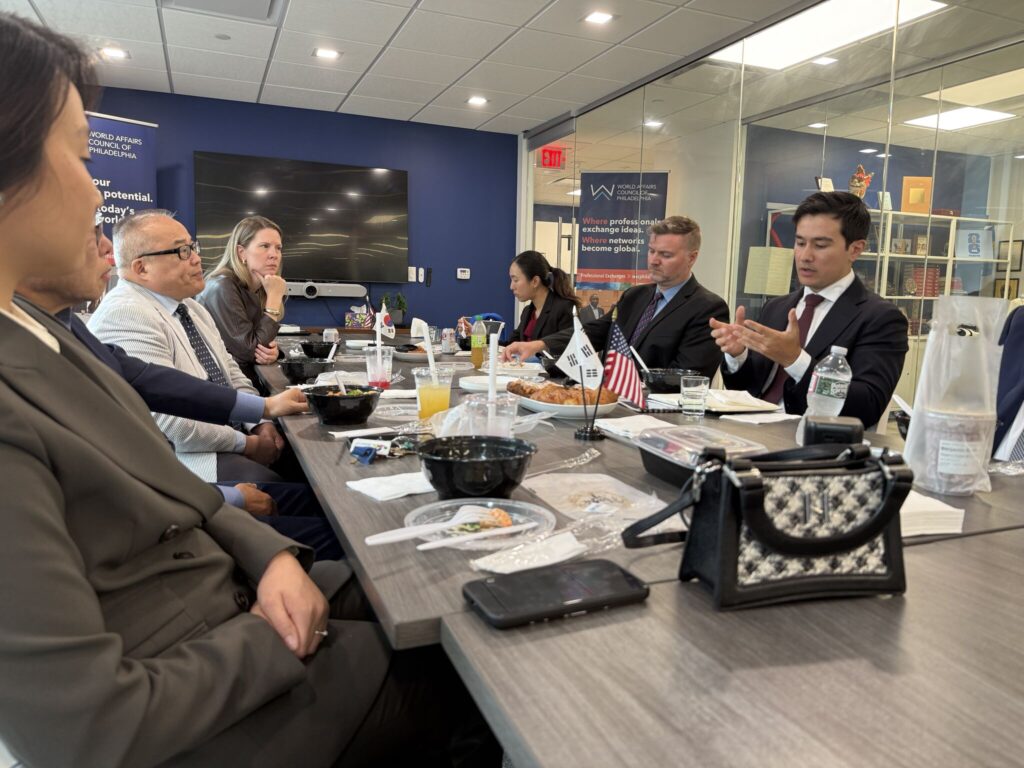
Following the meeting, the delegation joined a business roundtable that brought together Korean-American community leaders driving the local economy in Philadelphia. The discussion highlighted the growing contributions of Korean-American professionals across various sectors that anchor the region’s competitiveness. Participants also spoke candidly about the challenges facing businesses that rely on international inputs, but their outlook was mostly optimistic. Many here, as well as other individuals the delegation met throughout the visit, expressed pride in Philadelphia’s human capital and the “lunch pail” spirit that the city has built itself on.
The delegation’s community outreach also included a visit to Bodine High School for International Affairs, a magnet school co-founded by the World Affairs Council of Philadelphia and the School District of Philadelphia to cultivate the next generation of globally minded citizens. Delegates shared their personal and professional journeys in diplomacy, public policy, and international relations, offering students insight into the wide range of careers that engage with global affairs. Students from the World Affairs Club asked pointed and sophisticated questions about world politics, U.S. foreign policy, and the role of South Korea on the international stage. These were among the toughest and most engaging questions of the entire trip, which spoke extremely well to the students for their preparation and research!
That evening, the World Affairs Council of Philadelphia hosted a public event and panel discussion attended by a sold-out crowd. The program explored the current state of the U.S.-South Korea alliance, economic cooperation, and regional security. Panelists discussed, among other things, how the United States and South Korea are modernizing their alliance to address emerging challenges, including vulnerable semiconductor supply chains and a growing China-North Korea-Russia “axis of upheaval.”
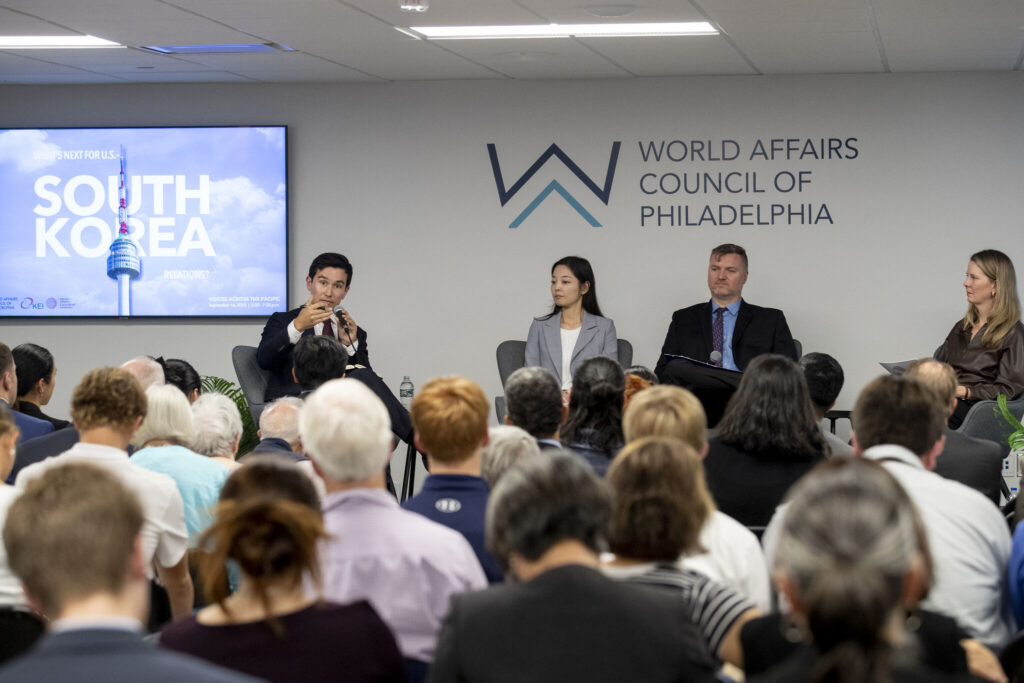

One theme that resonated throughout the evening was the growing public interest in trilateral cooperation among the United States, South Korea, and Japan. Such a topic is usually confined to policy and foreign affairs specialists, so it was notable that trilateral cooperation has entered mainstream public discourse as a defining feature of Indo-Pacific geopolitics. Audience members expressed curiosity about how this cooperation could shape regional peace and security in the years ahead.
By contrast, there was relatively limited focus on North Korea. While inter-Korean relations are no less severe than five years ago, discussions suggested that the American public increasingly views North Korea as one of many factors in a broader strategic environment. The diminished public focus on North Korea may also reflect South Korea’s rising global stature, as well as the U.S.-South Korea alliance’s maturation into a multifaceted partnership that extends beyond traditional security.
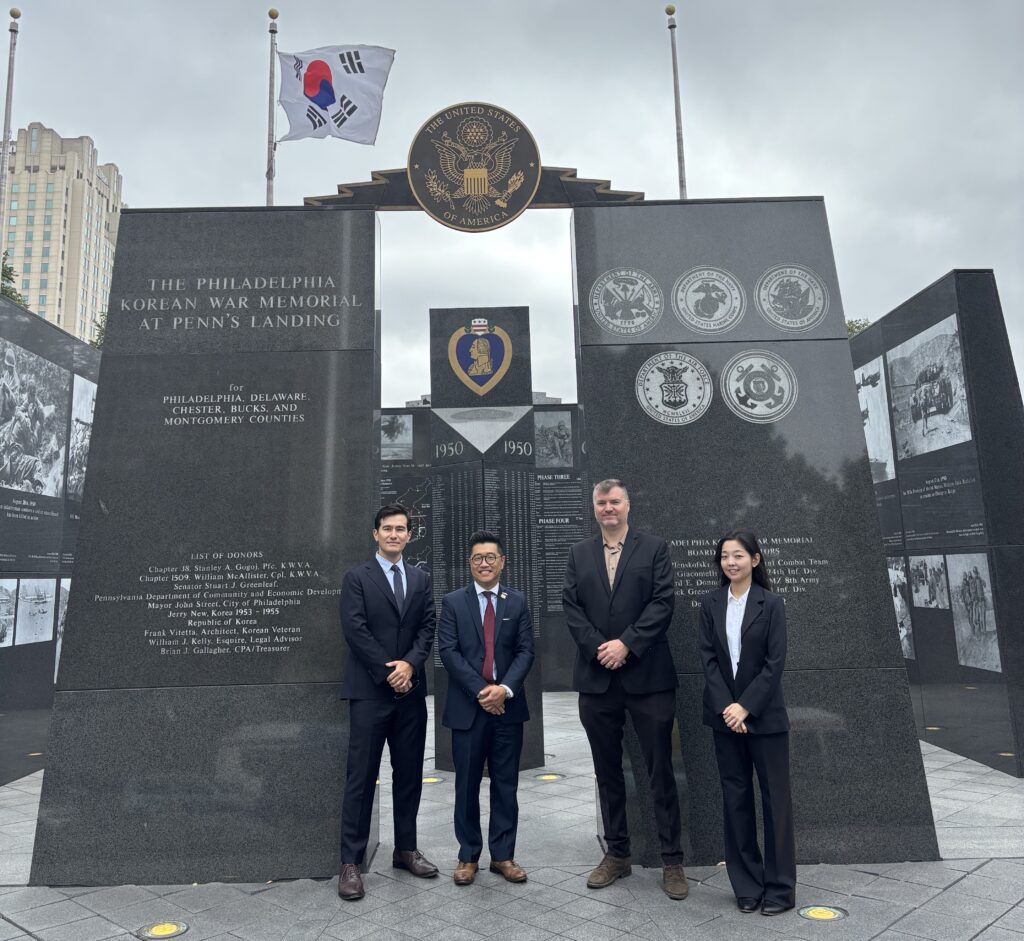
The delegation also visited the Philadelphia Korean War Memorial, which honors Pennsylvanians who served during the Korean War. Dongkun “Tom” Kang, deputy chief of staff for Councilwoman Quetcy Lozada and a member of the board of the Korea War Memorial, reinforced that the historical foundations of the alliance and the enduring local connections to that shared history. For the delegation, the visit was a reminder that the U.S.-South Korea partnership’s modern economic and security dimensions are impossible to achieve with the commitments forged more than seventy years ago.
Throughout the visit, what stood out most was Philadelphians’ deep pride in their city. Across all meetings, participants highlighted Philadelphia’s potential and confidence in its continued resurgence. Many described the city’s greatest asset as its human infrastructure: a diverse, talented, and civically engaged population that fuels innovation and growth. Philadelphia’s mix of historic legacy and forward-looking ambition mirrors South Korea’s own economic journey, making it a natural partner for exchange and collaboration.
The presence of a large conglomerate, Hanwha, expands opportunities for technical exchanges, university partnerships, and apprenticeship pipelines that link maritime programs in Philadelphia to those around the world. Port-side pilots in autonomy and greener propulsion lead to shared standards, and people-to-people ties deepen as Korean industries and culture expand in local communities across the United States. According to KEI’s latest public opinion poll, two-thirds of Americans hold favorable views of South Korea, 60 percent say culture improves the country’s image, and strong majorities support the alliance and open trade.
Lastly, discussions across the city touched on the broader role that U.S. cities can play in deepening global ties with and between foreign countries. South Korean investments in the United States have grown by tens of billions of dollars in just a few short years and will reach potentially hundreds of billions in the near future. Cities like Philadelphia offer a compelling combination of logistical connectivity, research capacity, and skilled workers. Thus, Philadelphia and the state of Pennsylvania can play an outsized role in strengthening people-to-people and business-to-business ties that underpin the U.S.-South Korea alliance.
Arius Derr is Director of Communications at the Korea Economic Institute of America (KEI) in Washington, DC. All views are the author’s alone.
Feature and in-line images courtesy of the World Affairs Council of Philadelphia.
KEI is registered under the FARA as an agent of the Korea Institute for International Economic Policy, a public corporation established by the government of the Republic of Korea. Additional information is available at the Department of Justice, Washington, D.C.