
Press Release: KEI Publishes Korea Policy Vol. 4, Issue 1 on the U.S.-Korea Joint Fact Sheet
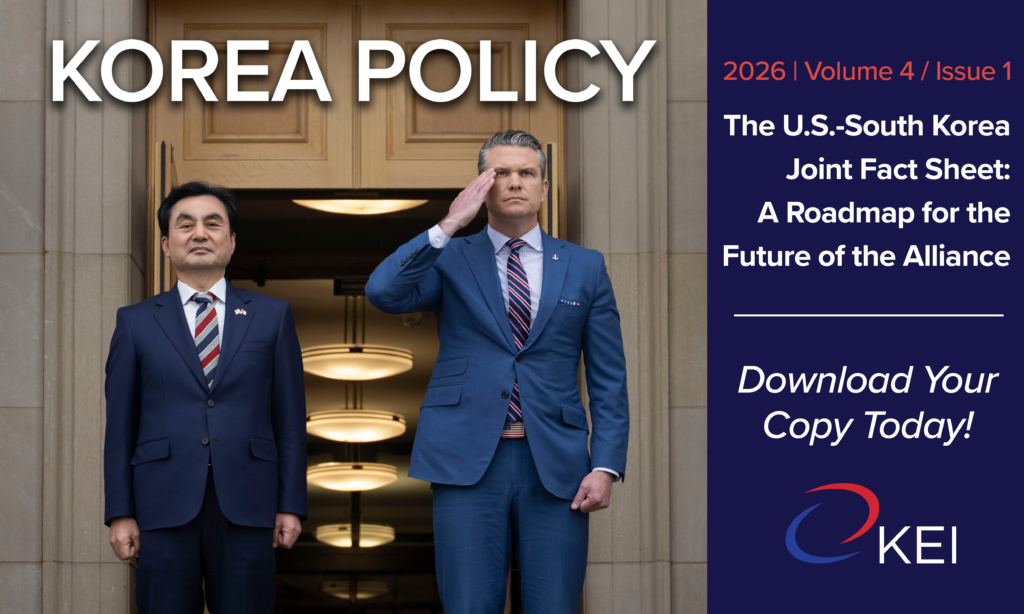
The Korea Economic Institute of America (KEI) is pleased to issue Vol. 4, Issue 1 of its flagship journal, Korea Policy.
July 1, 2026
The Korea Economic Institute of America (KEI) is pleased to issue Vol. 4, Issue 1 of its new flagship journal, Korea Policy. Our online journal carries forward the objective and spirit of KEI’s previous publications, the Academic Paper Series’ (APS) On Korea publication, and the Joint U.S.-Korea Academic Studies publication. Like our previous publications, Korea Policy identifies and explores the array of security, economic, and political issues and policy trends related to Korea and the U.S.-Korea alliance. The journal offers academically rigorous and policy-relevant research.
Korea Policy papers are written by academic scholars and policy experts from the United States, South Korea, and around the globe. The objective is to provide opportunities for recognized specialists and new voices to present fresh research and innovative thinking on Korea, the region, and related international issues. Each issue covers a broad, unifying theme and is arranged into two sections of articles. Before publication, working papers of these articles are presented as part of our Korea Policy series at KEI’s office in Washington, DC.
The papers in Vol. 4, Issue 1 exemplify the breadth and depth of policy issues relevant to the U.S.-Korea alliance. They are original pieces written exclusively for this issue over the last six months. KEI distributes the final publication to government officials, the private sector, policy institutes, and educational institutions around the world, and features the digital publication on the KEI website for the broader public.
Contributions in this issue fall under the theme, The U.S.-South Korea Joint Fact Sheet: A Roadmap for the Future of the Alliance. The first section examines alliance modernization across new strategic frontiers, taking up the core issues raised in the Joint Fact Sheet: deterrence posture and the transition of wartime operational control, defense industrial cooperation, nuclear-powered submarine acquisition, and the cyber domain. The second section turns to alliance adaptation in an era of transformation, revisiting Korea’s external economic strategy, the future of the U.S.-Korea civil nuclear partnership under the 123 Agreement, and export controls on AI infrastructure.
For over forty years, KEI has produced objective and informative analyses and highlighted important policy research on Korea. We hope you find this volume of Korea Policy to be a useful contribution.
Table of Contents
Introduction: How the U.S.–South Korea Joint Fact Sheet Lays the Future of the Alliance
Gilbert Rozman
Section 1: Modernizing the U.S.–South Korea Alliance for New Strategic Frontiers
- The Path Forward for Alliance Modernization and Redesigning the U.S.–South Korea Alliance — In Hyo Seol
- The Future of U.S.–South Korea Defense Industry Cooperation on AI and Cybersecurity — Eun-ho Kang
- Pathways to Cooperation for South Korea’s Successful Nuclear-Powered Submarine Acquisition — Jihoon Yu
- Enhancing Strategic Alignment in Cyberspace Within the U.S.–South Korea Alliance — Sebastian Garcia
Section 2: Alliance Adaptation in an Era of Transformation
- South Korea’s New External Economic Development Strategy — Taeho Bark and Dongchul Kwak
- Rethinking the U.S.–South Korea 123 Agreement in a New Strategic Era — Kayla T. Orta
- Redefining National Security Governance through Access and Compute: U.S.–South Korea Export Controls on AI Infrastructure — ChangHee Kim
This material is distributed by KEI on behalf of the Korea Institute for International Economic Policy. Additional information is available at the Department of Justice, Washington, DC.