Three Drivers for Trade and Innovation Tie Oregon to South Korea
A majority of Americans (58 percent) support South Korea developing nuclear-powered submarines, according to the 2026 Korea Economic Institute of America (KEI) survey.
By Scott Snyder

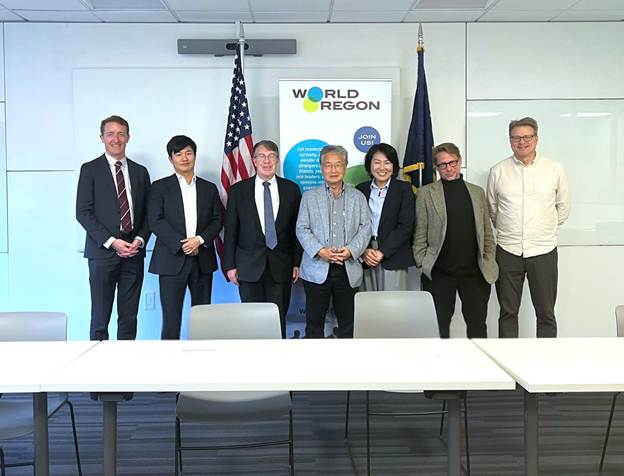
Blueberries, food testing, and drones are driving Oregon’s trade and innovation ties with South Korea, and all three were on display during a three-day visit to Portland by the Korea Economic Institute of America (KEI) as part of its longstanding Future of Korea (FOK) program. The trip, hosted by WorldOregon, came less than a year after Oregon Governor Tina Kotek led a trade delegation to Seoul and Tokyo.
From October 23–25, 2026, KEI participated in meetings and briefings on the Oregon-Korea trade relationship. The visit followed the establishment of a Korea Desk at Business Oregon last May, led by Sharon Kim-Geib. The visit provided a readout on the impact of a November 2025 trade delegation to Seoul and Tokyo led by Governor Kotek that aimed to bolster Oregon-based exports in agriculture and advanced technology.
The KEI visit spotlighted three drivers of exchange between Oregon and Korea: two agricultural drivers and one “autonomous” driver. First, Oregon is a leader in exporting blueberries to Korea, in addition to being a leading exporter of wine to Korean consumers. In addition, Oregon’s exports to Korea must transit via other cities, including Seattle, in the absence of a direct commercial flight between Portland and Incheon. Although former Korean Prime Minister Kim Min-seok endorsed the idea of a direct flight between Incheon and Portland during his meeting with Governor Kotek in November 2025, the route has not yet been finalized.
The second promising driver of agricultural trade between Oregon and Korea was highlighted during a visit to the Food Innovation Center (FIC) at Oregon State University. The FIC plays an important role in consumer pre-market testing of a wide range of food products. The information gained from such testing helps businesses refine a product’s taste, texture, and packaging before release. For instance, a producer of Korean snack foods has pretested products at the FIC in anticipation of expanding sales to the U.S. consumer market. The FIC is also helping Oregon seaweed harvesters develop products for consumption and export. The FIC also researches organic compounds that could replace chemical compounds in various cosmetic products.
The “autonomous” driver of exchange between Oregon and Korea is a unique accelerator program focused on developing unmanned aircraft systems (UAS), or drones. Through an agreement with the Korea Investment Accelerator, the Oregon UAS Accelerator, led by Executive Director Joseph Wyno, brings Korean UAS founders to Oregon for a twelve-week training program to test, commercialize, and collaborate on the development of advanced air mobility, ground and maritime robotics, and AI and mission software alongside founders from Oregon and other parts of the United States. The Korean entrepreneurs will bring their ideas, dreams, and hardware from Korea to Pendleton, Oregon, where land and airspace for testing are plentiful.
More importantly, the unmanned systems ecosystem curated by the accelerator project seeks to bring together Korean entrepreneurship and technological innovation with practical applications and business development mentorship to develop projects that the U.S. military and defense contractors at the forefront of drone technology development might use. The latest cohort of American and Korean innovators will present their pitches to investors, judges, and ecosystem partners at the Oregon UAS Accelerator pitch day on November 13, 2026, at Big Pink in Portland.
Think Shark Tank for Korean drones, where the sky is the limit for applying Korean innovation to global problems.
Scott Snyder is President and CEO of the Korea Economic Institute of America and author of South Korea at the Crossroads: Autonomy and Alliance in an Era of Rival Powers. The opinions expressed here are his own and do not reflect those of KEI.
This material is distributed by KEI on behalf of the Korea Institute for International Economic Policy. Additional information is available at the Department of Justice, Washington, DC.