
The U.S.-South Korea Alliance Has Always Depended on Its Managers
There is growing alarm in Seoul, echoed among American experts on Korea, over the state of U.S.-South Korea relations.
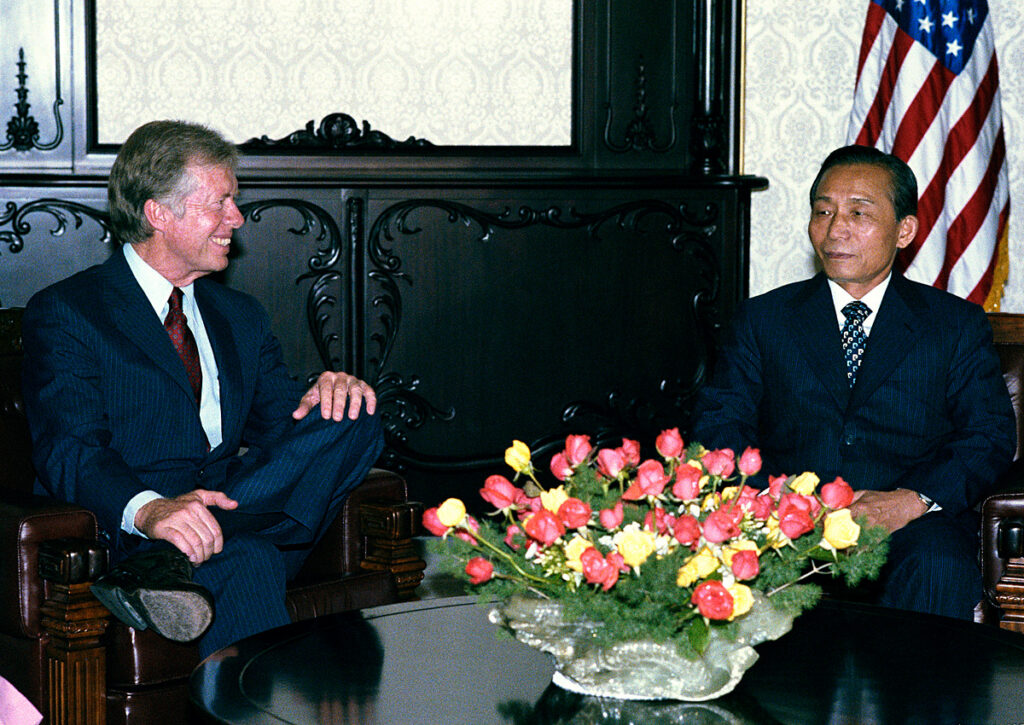
There is growing alarm in Seoul, echoed among American experts on Korea, over the state of U.S.-South Korea relations. The alliance survived a worse stretch in the 1970s because experienced diplomats on both sides kept the relationship on track. Those people are now in short supply on the American side.
In the economic realm, there is a clear gap over how to select projects that would fulfill South Korea’s pledge to invest USD 350 billion in the United States, including the proposed Alaska liquefied natural gas pipeline. Complaints from U.S. investors and lawmakers over Seoul’s handling of the Coupang data breach further exacerbate bilateral tensions.
Security ties are equally fraught, with disagreements over the timing of the transfer of wartime operational control (OPCON), South Korea’s plan to build nuclear-powered submarines, and policy coordination on North Korea. Tensions even extend to delays in issuing visas to ruling party legislators.
“Communication between the two countries is not just strained but entirely severed,” a recent editorial by the conservative Chosun Ilbo stated. South Korean Ambassador to the United States Kang Kyung-wha expressed her own frustration over the lack of senior-level dialogue. For the conservative outlet, however, the fault also lies with Seoul. “Despite this situation, it is unclear what efforts this government is making” to improve bilateral relations.
Divergence Across History
Korean national interests have often diverged from American strategic goals. Syngman Rhee, South Korea’s first president, opposed the terms of the armistice that ended the Korean War, consenting only in exchange for the Mutual Defense Treaty.
Relations with Park Chung Hee, who came to power in a military coup in 1961, were even thornier. Park was a fierce Korean nationalist and, according to a close former aide, uncomfortable with Americans. The two countries collided over North Korea policy, economic goals, human rights, and democracy.
The 1970s were perhaps the alliance’s most trying period, in some ways resembling the current moment. As now, South Koreans had developed deep doubts about the durability and reliability of the alliance, fed by the Vietnam War and the United States’ unilateral decision to withdraw one of its two infantry divisions stationed on the Korean Peninsula.
At the same time, Park faced growing U.S. pressure over his handling of internal politics, spurred by the declaration of martial law in 1972, the revision of the constitution, and the repression of opposition politics.
Fearing U.S. abandonment, Park made two seemingly contradictory decisions. He reached out to North Korean leader Kim Il Sung, who also feared his Chinese backers might sell him out after Beijing’s opening to Washington, and the two sides held high-level talks in 1972 that proved short-lived.
Park also began a secret program in 1971 to develop nuclear weapons, clearly aimed at preparing for U.S. retreat from South Korea. The seriousness of this effort was not discovered until late 1974, when a young CIA officer provided proof to a skeptical Washington establishment that South Korea’s research had advanced to designing a crude warhead.
During much of this time, my father, the late American diplomat Richard L. Sneider, served as U.S. ambassador to South Korea. He told The Wall Street Journal shortly before his 1978 departure that it was as “arduous a period as any alliance relationship has had in recent history.”
In researching this period for a forthcoming book, I was struck by how much the current issues in our alliance, and in our foreign policy more broadly, simply revisit the past. In the spring of 1975, my father sent a top-secret cable to Washington calling for an urgent review of the U.S.-South Korean alliance. Korea was “no longer a client state,” he wrote, but was “well on its way to middle power status with ambitions for full self-reliance including its own nuclear potential.”
Sneider recommended creating a new partnership, one more akin to the United States’ alliances with NATO or Japan. He also pushed for quiet but tough diplomacy to dissuade Park from heading down the nuclear road. That campaign finally succeeded, but not before my father warned Park that the entire security alliance was jeopardized.
The alliance faced two other major strains during this period. In 1976, North Korean soldiers brutally murdered two American officers in the infamous tree-cutting incident in the demilitarized zone. President Park and Commander of U.S. Forces Korea Joseph Stilwell considered retaliatory measures, some of which could have triggered a much broader conflict. Voices of diplomacy and restraint, including that of my father, prevailed.
That was followed by an even more serious threat to the alliance: the plans of newly elected U.S. President Jimmy Carter to withdraw all American forces from the Korean Peninsula, fueled in part by a passion for human rights. Those plans were opposed throughout the U.S. national security establishment and by Congress, and ultimately largely abandoned.
The perilous state of the alliance reached a peak in 1980 with the Gwangju Uprising against military rule, when hundreds of South Korean civilians were killed by troops deployed—with the alleged acquiescence of the United States.
The Importance of Leadership
The long-term success of the alliance depends, of course, on shared values and common interests. But it also depends on the skills and commitment of alliance managers, diplomats, military officers, and intelligence officers who work every day to keep channels of communication and understanding open.
The South Korean government has experienced alliance managers, including Director of National Security Wi Sung-lac and Minister of Foreign Affairs Cho Hyun, both veteran diplomats. On the American side, however, the Department of State and National Security Council have been stripped of senior hands, with possibly thousands of Foreign Service Officers gone since President Donald Trump returned to office. Privately, and occasionally in public, South Korean officials lament the inability to engage with senior decision-makers in the United States. Amid even greater uncertainty about the future of U.S. policy following the dramatic midterm elections, alliance management has become even more challenging.
In a report card on the bilateral relationship delivered at the conclusion of his tour in Seoul, my father reflected on the failure of both the United States and South Korea to recognize the need for change as the alliance moved beyond a patron-client relationship. He argued that the need was to shift from a “big brother” relationship to one of real partnership. He concluded this reflection with words that ring true today.
“Perhaps,” Sneider wrote, “the most difficult lesson to learn is the question of style in American diplomacy. Time and time again, hard-nosed American tactics, the failure to consult, the failure to take into account the pride and ego of our allies have delayed achievement of our objectives. The Korea case is not unique. The problem is unfortunately endemic to many of our relations in Asia. Dependence on America and American muscle is all too evident to the Asians, but they resent being reminded of it by heavy-handed pressures, particularly in a period when they are gaining new strength, new confidence and a new sense of nationalism. This may be the ultimate lesson of the Korean experience over recent years.”
Daniel C. Sneider is Nonresident Distinguished Fellow at the Korea Economic Institute of America (KEI). The views expressed here are the author’s alone.
This material is distributed by KEI on behalf of the Korea Institute for International Economic Policy. Additional information is available at the Department of Justice, Washington, DC.