
Americans Back South Korean Nuclear-Powered Submarines but Oppose Nuclear Weapons
A majority of Americans (58 percent) support South Korea developing nuclear-powered submarines, according to the 2026 Korea Economic Institute of America (KEI) survey.
By The Korea Economic Institute of America (KEI)
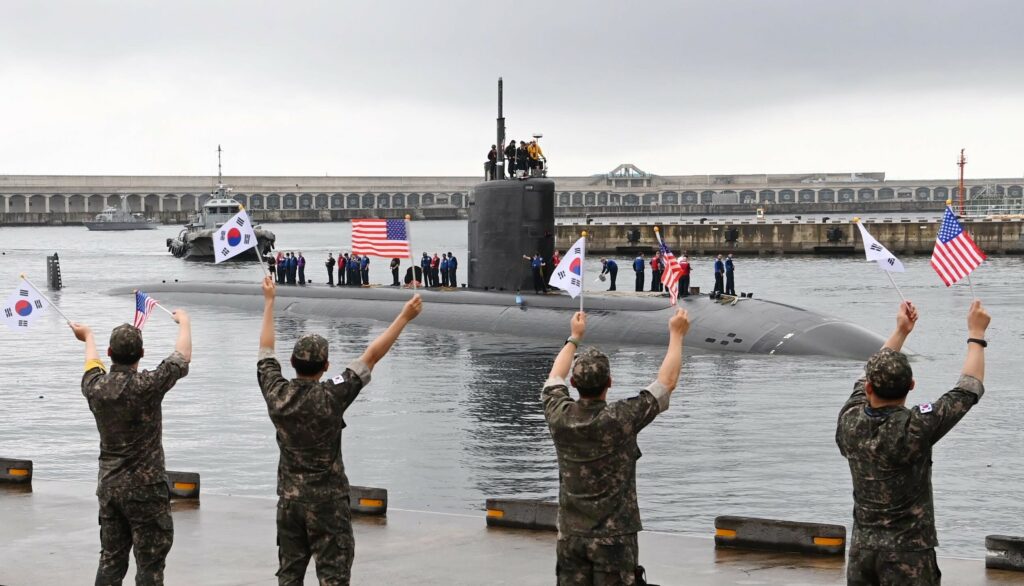
A majority of Americans (58 percent) support South Korea developing nuclear-powered submarines, according to the 2026 Korea Economic Institute of America (KEI) survey, conducted with YouGov. But support for nuclear-powered submarines does not extend to nuclear weapons. Seven in ten (71 percent) oppose South Korea developing a nuclear weapon, a view that holds across party lines.
Questions about the defense of South Korea and the future of regional security remain central to the U.S.-South Korea relationship. As the alliance evolves and South Korea takes on more responsibility for its own defense, a potential addition to its military capabilities is nuclear-powered submarines. South Korea took a step in that direction in May 2026, when it released a plan to develop such a submarine. The survey asked separately about nuclear-powered submarines and nuclear weapons.
Majorities Across Parties Support Nuclear-Powered Submarines
Support for South Korea developing nuclear-powered submarines is largely consistent across Democrats (56 percent), Republicans (64 percent), and Independents (62 percent). Four in ten Americans (42 percent) oppose South Korea’s development of nuclear-powered submarines.
Most of that support is moderate in intensity. Some 43 percent of Americans somewhat support South Korea developing nuclear-powered submarines, and 15 percent strongly support it. Opposition divides almost evenly between those who somewhat oppose and those who strongly oppose. Republicans show the broadest support, with 50 percent somewhat supportive and 14 percent strongly supportive. Democrats are the most divided, with 56 percent in support and 43 percent opposed, while Independents are the most likely to strongly oppose (21 percent).
Opposition to Nuclear Weapons Extends to Close U.S. Partners
Majorities oppose each of the nine countries in the survey developing nuclear weapons. On average, roughly three-quarters of the American public (77 percent) oppose any country, including South Korea, developing nuclear weapons. Opposition is highest for Iran (91 percent) and lowest for Australia (66 percent). For South Korea, opposition is consistent among Democrats (69 percent), Republicans (72 percent), and Independents (71 percent).
Opposition to a South Korean nuclear weapon (71 percent) is lower than for Qatar (86 percent), Saudi Arabia (85 percent), and the United Arab Emirates (84 percent). While higher, it is closer to that for Australia (66 percent), Germany (69 percent), and Japan (67 percent). Even for those three U.S. allies, roughly two-thirds of Americans are opposed.
Support for the alliance itself remains high across party lines. A majority (56 percent) support either increasing (8 percent) or maintaining (48 percent) the current 28,500 U.S. troops in South Korea. If North Korea were to invade, 71 percent of Americans would favor using U.S. troops to defend South Korea, including 73 percent of Democrats, 77 percent of Republicans, and 71 percent of Independents.
Altogether, the findings show broad support for the bilateral relationship even as Americans differ on how some parts of that relationship should develop.
Data from this article originally appeared in “What Americans Think of the U.S.-South Korea Alliance Before the Midterms,” an annual public opinion survey from KEI. The 2026 iteration was authored by Karl Friedhoff, Nils Wollesen Osterberg, and Angela Lee. Get the full report by clicking here.
This material is distributed by KEI on behalf of the Korea Institute for International Economic Policy. Additional information is available at the Department of Justice, Washington, DC.