
Speakers

Kathleen Stephens
Former U.S. Ambassador to the Republic of Korea (2008-2011)
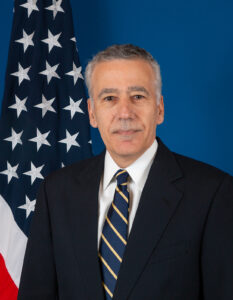
Philip Goldberg
Former U.S. Ambassador to the Republic of Korea (2022-2025)
Moderators
Event Details
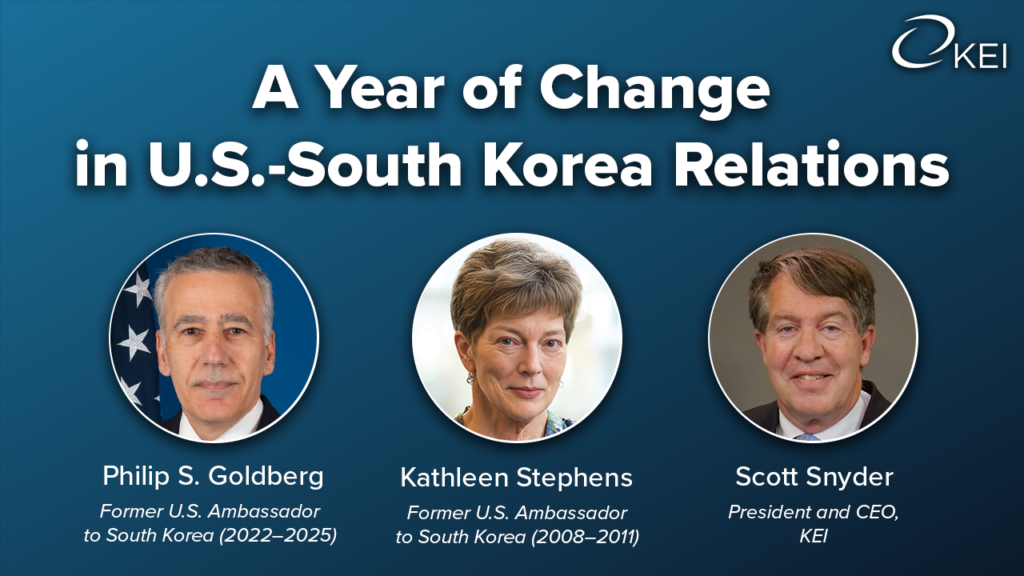
The past year has introduced both expanded opportunities and unprecedented volatilities to the U.S.-South Korea relationship. From nuclear submarine cooperation and a new investment agreement to tariff-related uncertainties and immigration-related tensions, the state of the partnership between the United States and Korea has important implications for regional and global security, economic, and political dynamics. What has changed, what has held, and what does the next year demand of both governments?
Two former U.S. ambassadors to Korea take stock. Ambassadors Philip Goldberg (2022–2025) and Kathleen Stephens (2008–2011) join KEI President and CEO Scott Snyder to assess where the alliance stands as President Donald Trump faces a crucial midterm election and his Korean counterpart Lee Jae Myung wraps up his first year in office.
Transcript
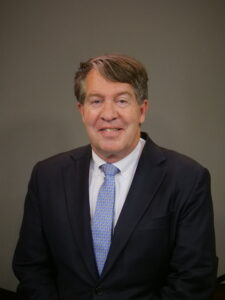
Scott Snyder:
Well, let me draw your attention. I’m Scott Snyder, President and CEO of the Korea Economic Institute of America, and thank you all for coming. We thank our virtual audience as well.
We have a treat for you today with two former ambassadors, Kathleen Stephens and Philip Goldberg, to give us a picture of where we stand in the U.S.-Korea relationship. This is the anniversary of a meeting that we had last year, which also included Ambassador Harry Harris, but it is also the first year of the Lee Jae Myung administration. We just had local elections this week in Seoul, and it is a great opportunity, I think, to assess where we stand in the relationship between the United States and South Korea.
Ambassador Stephens was ambassador in Seoul under the Obama administration between 2008 and 2011. Ambassador Goldberg was ambassador in the Biden administration from 2022 to 2025. Both of them are veterans of our Ambassadors Dialogue, a signature project that KEI does, where ambassadors from Washington and Seoul travel together with each other around the country for a week-long public diplomacy exercise. We are grateful for their past participation in that.
We also have our Ambassadors’ Memoir Book on display outside. This was really a project that Ambassador Stephens shepherded in her time as president of KEI. It contains a chapter that she has written, and it contains contributions by many ambassadors who served from South Korea in Washington and from the United States to Seoul over the course of several decades. Ambassador Goldberg is someone we hope to get a contribution from at some point in the future. No pressure. Whenever you are ready. I also want to highlight that we now have that publication available online, so it is much more readily available.
As I have been thinking about this event, I want to highlight what has occurred over the course of the past year. When Lee Jae Myung took office in June of last year, President Trump had already announced Liberation Day tariffs, and the major task, I think, of the new administration was to come to terms on the trade and investment side with Liberation Day and with the new investment framework.
Also last year, there were some meetings about the theme of alliance modernization. We have seen two summit meetings, one in August of last year between President Lee and President Trump at the Oval Office, and the other which took place in Gyeongju on the sidelines of the APEC meeting back in October. Through that process, I think we have a joint fact sheet that was released last November.
I think there are two major themes that I am really hoping we can delve into. One is the state of the economic and trade relationship in the context of what President Trump called Liberation Day, and the other is really the state of the alliance.
Before we get too much further, I want to ask both of you just to give a top-line view related to where you think the state of the relationship is at this point, and then we will try to dig into both sides of that relationship. Maybe I can start with you, Kathleen, for your initial thoughts about where we stand right now in the relationship after one year of President Trump and President Lee managing the relationship.
Kathleen Stephens:
Well, thank you, Scott. I have to say first of all, of course, it is great to be back at KEI. I really want to say how much I continue to appreciate all the great work that Scott, his leadership at KEI, and everyone at KEI is doing.
A lot of my answers are based now on the things I have been reading that KEI puts out in terms of its research, especially in this economic and trade field, which has become ever more salient over the last year.
It is also great to see so many from KEI and elsewhere, friends and old friends here today. When you ask me about the state of the relationship, just being in this room makes me a little more positive about it because I do see the range of people who over the years, sometimes a long time and sometimes more recently, have been really committed to this relationship between the United States and the Republic of Korea. I look forward to talking with a lot of you afterward as well as in our Q&A session.
What can I say about the past year? You have chosen a good week because, just getting up this morning and reading, as I think many of us do, what was in the Korean press last night, we have the local elections in Korea yesterday. We have the Under Secretary of State for Political Affairs doing consultations in Seoul. There are a lot of things we could talk about that have happened, or that are happening right now.
Looking over the last year, we have a fact sheet that talks about, especially with respect to the security relationship, “modernizing the alliance.” I actually honestly think that is a little bit of an anachronistic phrase. I think of what it is in Korean. I think we are actually redefining the relationship. There are some opportunities there, but it has been a very challenging year for the alliance and for the relationship. We will go into some of the details.
You mentioned already, basically, the abandonment of the Korea-U.S. Free Trade Agreement, which we used to regard as a pillar of the relationship, and its replacement with a rolling set of negotiations about tariffs and the economic relationship. I think there have been some positive aspects in that area. In some ways, it has gone a lot better than we might have feared. But it has also been obviously very, very challenging.
Similarly, in the security area, there has not just been what we say in shorthand, this very challenging geopolitical atmosphere we are in, but in a sense of questioning longstanding commitments. Overall, I would say the last year has been a time when some degree of stability and trust in the alliance and the relationship has been weakened.
There certainly have been efforts, and I think the Lee Jae Myung government, coming into power one year ago at a very challenging time, has worked very hard to try to bridge some of those challenges. But I think that is ongoing.
As we talk about the specifics, I would just say the overriding thing that I am looking at is that it is natural. It is a time to redefine the relationship. But as we do that, I think we are going to have to work with what I think is now a bit of a deficit of trust and confidence, and in some ways, may I say, diplomacy, to make all that happen.
Philip Goldberg:
I agree with Kathleen, as always. I have to be careful. Thank you very much for the invitation, Scott. I always like coming to KEI also.
I think we are in the midst of a restructuring of this relationship. The traditional U.S.-Korea military and security alliance based on the Mutual Defense Treaty seems to be changing, and much of that is being dictated rather than negotiated. Some of it is to the liking of the Republic of Korea, and some of it is not, but most of which is. I will get into that in a second.
That means, Washington, through its ideas about strategic flexibility, about moving the responsibility for North Korea to South Korea only, with maybe the nuclear umbrella still out there for the United States to handle. The reason that Lee Jae Myung and the Lee administration like many parts of this is because it fits their view of what should be happening with OPCON transfer and with an ability, being forced in part by the Trump administration, to take on more responsibility for its own defense.
They do not like certain aspects of the way the DMZ is run under the United Nations Command, even though they do not have as much say on that. But there are many things in this, including the expansion of the military-industrial base in Korea, that benefit from it. I think the Lee administration is taking advantage of that.
But the fact is that it is being largely dictated by Washington and by President Trump and by members of his administration. It is not something that is a well-thought-through agreement, as was much of the consensus over the years having to do with the Mutual Defense Treaty.
The trade and investment side is very similar. When we were here a year ago, the Trump administration had come in and said, “We are going to put 15 percent tariffs.” It may be a little less now because of all of these court decisions that are very difficult to follow, exactly what the tariff is today. But you are going to pay this, or if you do not want to pay that, we want $350 billion in investments.
The Koreans do not really have $350 billion that they can just go access. They think they got a better deal out of it than Japan maybe, because Japan had $550 billion at stake to have their tariffs reduced. But again, this is all being done from one side to the other, and so it has become extremely transactional.
If you look at that fact sheet, it is a transaction sheet. It does not have to do with many of the issues that those of us who have dealt with the U.S.-Korea alliance for many years have always fallen back on, which is talk about “go together” and “fight tonight” and all of those slogans that we always talked about, which always have a basis in a great alliance. It is changing. So that is where I would come out.
Scott Snyder:
Let me drill down a little bit on the trade and investment side because that obviously has been a very dynamic and ever-changing area. In particular, the investment flows. We have this framework, and you mentioned seven critical areas. South Korea, regardless of how much they might have liked or not liked the process, they are at a point where they have a committee, and they are going to be potentially naming investments.
Maybe more significantly, I would argue that there already is a prior flow. We saw upward of $140 billion of investment announced during the Biden administration. In that respect, I am curious about how you view that arrangement in terms of whether or not it is sustainable and what it might mean in terms of the way in which the United States and South Korea are tied together. Phil, I am going to have you pick up, and then we will come back to Kathleen.
Philip Goldberg:
As I mentioned, it is not as though South Korea is just going to go to the bank and take $350 billion and hand it to the United States to invest as it would like, even though there will be consultations on it. I think the Secretary of Commerce here wants a large role in how those investments are made.
I believe there was an agreement that it would be $20 billion a year for the non-shipbuilding part of the $350 billion. That brings it over 10 years. Well, 10 years is a long time, and the current administration in the United States has two and a half years left in office. Whether that all will continue is quite an issue because there are many who speculate in Europe, in Japan, and in the ROK, whether or not this is aspirational and will not necessarily be the final figure.
On shipbuilding, which is $150 billion of it, there were some purchases made by Korean companies. There are commitments and a great ability by South Korea to help us build ships. But my guess is that if we are really going to do that, most of that will be done in South Korea, not as was originally envisioned here. It will take so long to gear up to do that. So it is going to be slow. Whether it all comes in is really open to question, in my view.
Scott Snyder:
Kathleen, I want to follow up on that by asking you: overall, in the trade and investment area, is this an area that is driving us closer together, or is it an area that is going to be riven by conflict and drive us apart?
Kathleen Stephens:
I certainly hope it draws us closer together. I share the concerns that Phil has outlined about the $350 billion and the vagueness and uncertainty around that. But notwithstanding the mournful death of the FTA as the FTA and what is happening now, I think what we have seen over the past couple of decades is how Korean investment in the United States has drawn us closer together.
You mentioned earlier investment figures, and I know you and KEI and all of us have, whether we visited Georgia or Austin, Texas, or Indiana, seen the way that Korean investment in these communities is really transforming and has the potential to do even more for our manufacturing base and economic life in local communities. That drives us closer together, and it certainly has the potential to. I welcome that.
I also, of course, welcome the increased trade. We have seen that. But I think what we go back to again is the challenge of unpredictability. For example, some of the investments that were committed to in the previous American administration under the IRA and the CHIPS Act were based on assumptions about the business conditions, tariffs, and economic conditions related to things like EVs and tax breaks. Investments were made. That changed. Things do change. We understand that in government and in business. But I think that sense of unpredictability has undermined some of the potential for these investments and makes the anticipated ones even more challenging going forward.
I do think this is the future of the relationship in many ways, and it is impressive to see the transformative things that are happening in local communities as Korean investment comes in.
There are other things in terms of a government role that need to be addressed, and one that I hear often, as I am sure you all do, is the issue of visas. We had this very highly publicized immigration raid on the large Hyundai investment in Georgia some months ago, something which the Trump administration immediately said was a mistake, apologized for, sent out the Deputy Secretary, and has said it is going to take steps to address.
How do you support billions of dollars in investment in building semiconductor plants and EV plants and shipbuilding and all the rest if you cannot ensure that the experts who are coming to this country, whether they are the engineers or the business people, are going to be able to work in safety and stability as they build up these investments? That requires some action on the part of the U.S. government. I understand that the administration is committed to doing that, but those are the kinds of things that I think we still have a ways to go on to get to the point where we ensure that these investments and continued trade can proceed.
On trade, of course, again, I think it is unpredictability. What I hear again and again from Koreans is that it is almost as if they can adapt to certain tariffs, but how long do they last? We just had a few days ago this announcement of additional tariffs which may or may not apply to many, many countries if some of their products are considered to have been derived from forced labor. So that is another uncertainty, whether that will attach to Korea or not.
Again, I think a lot of work will go into that. I think the Koreans are very committed, as we saw in these meetings in Seoul, to trying to see how we can work through these things. Many people in the United States, I think, want to see those things worked out. But that level of instability and uncertainty is a big drag, I think, on these very lofty and welcome goals.
Philip Goldberg:
Just to simplify this, in my view, what the Biden administration was doing was trying to promote these investments through incentives. The Trump administration is trying to do it through disincentives, which is tariffs, while the IRA and the CHIPS Act were designed to work together to try to bring these investments.
Scott Snyder:
The main themes I am hearing so far are that, in the face of heightened uncertainty, we are involved in a redefinition and even a restructuring of the relationship. We have dealt with the trade side somewhat, and so I want to turn to the phrase “alliance modernization” and the Trump administration’s National Defense Strategy.
We know that South Korea has been praised for pledging to meet the 3.5 percent of GDP threshold. But there are all sorts of other issues: OPCON transition, U.S. military equipment purchases, which were part of the joint fact sheet.
Phil, as part of this restructuring, do you think we are actually moving together more closely, becoming more closely integrated, or are we moving apart? There is a sense in which the issue of credibility has come up. It is fair to ask, when we hear discussions of autonomy, whether that means autonomy from the alliance or autonomy within the alliance. What is your take?
Philip Goldberg:
My own view is that it means moving apart in certain fundamental ways, where we are looking to use our presence and our troop presence more for regional issues. We did that basically, as I mentioned earlier, on our own. We announced this policy. The Koreans tried to catch up with that, and as I also said, I think this suits many aspects of the current Korean administration’s outlook, which is to try to bring more responsibility for Korea’s defense to itself. So there is a congruence of view on that.
But it also means moving apart to some extent. Where we do have opportunities for coming together more is in military-industrial cooperation, maybe developing weapons together. We know, for example, what is happening in the drone area and counter-drone technology. There are all kinds of things that we can do together on that. But again, it will be a little bit more transactional. It will not necessarily be part of this traditional alliance.
Scott Snyder:
Kathleen, I want to ask you specifically about OPCON transition. That issue has been around now for a long time. How would you address that in the context of the evolution of the alliance relationship?
Kathleen Stephens:
I actually think that some of these modifications in our security alliance and our security cooperation do not necessarily drive us apart. Maybe I am slightly more optimistic about that. I agree about the cooperation in the military, industrial, and technological areas. I think that is bringing us closer and closer together and has enormous potential.
With respect to OPCON transfer, we use the shorthand now. I do think the time may be right for that. I was telling Scott earlier, and I do not want to go into a big digression. I remember because I was first in Korea in the 1970s. Combined Forces Command was established in 1978. It has not been here since the Korean War. It was established as a direct response to the crisis in the alliance at the time, which was President Carter’s pledge to withdraw all U.S. troops from South Korea. President Carter, listening to his advisors and the Koreans, decided not to do that. But out of that grew a Combined Forces Command, which put an American general with a Korean deputy in charge of all the forces in Korea during wartime and peacetime.
Now I am doing a long digression. That was 1978. I was in Korea in the 1980s as a political officer during the period of democratization, when there was a lot of anger in many circles in Korea, kind of suppressed because there was not much freedom of speech, about whether or not the United States had more responsibility for some of the things, including Gwangju in 1980, because it had operational control of all the troops. I had many, many Koreans say to me, “Why did the U.S. general not stop the troops from going to Gwangju?”
I am happy to talk afterward about what that conversation is, and there is a lot you can read about that. But OPCON was something people talked about, and we had to explain what OPCON was and what it was not, who was under it. It was all kind of complicated. Some people in this audience know that well.
I think that is what grew into the 1990s, when Roh Tae-woo, elected under a democratic election, said, “Let us have OPCON transfer.” In 1992, peacetime OPCON was transferred to the Korean forces. Wartime remained under U.S. forces. So this has been a longstanding discussion, and I think a lot of Koreans do not really know the background now.
But here we are in 2026, and it is not the end of the alliance if we have a change in operational control after all these years, after almost 50 years of CFC. It depends on how that change is managed, but I think it can be managed. Perhaps this is the moment when the stars align, if you like, and we come out with something that does not necessarily drive us further apart.
Similarly, I think this idea of strategic flexibility, which I think was first used during the George W. Bush administration by Donald Rumsfeld, was the idea that we have these American troops in Korea, so why can they not go and do other things? There was discussion about it then, and in some ways it has been renewed now. I think we will find a way through that with an understanding based on, you know, obviously, the Korean government and the Korean people have sensitivities about a lot of things. Those can be discussed, and I think there is a way through those.
I am positive about if we go in, we can address these things. But underlying again is whether we come out of it with a greater sense of confidence and trust about the commitment. I know that sounds a bit ephemeral. That is not in the fact sheet as something we are going to work on, but that is the overlay, I think, of all these discussions. Are we going to increase the amount of confidence and trust that we have?
Scott Snyder:
It is amazing. Back in the 1980s, I think the OPCON transition issue was the elephant in the room that took all the oxygen out of the room in the U.S.-Korea relationship. So it is remarkable that a piece of it is still there.
I want to move on a little bit to North Korea. Phil, I want to ask about North Korea’s abandonment of an overt unification policy. It feels like Kim Jong Un has turned his back on South Korea, and we have this policy that I would describe on the part of North Korea as “hostile coexistence.” Lee Jae Myung wants it to be a peaceful coexistence. Is there a pathway by which it is possible to get Kim Jong Un to turn back around and face South Korea?
Philip Goldberg:
I think the only conditions that would cause that are some sort of rupture, which I do not see, in the current North Korean relationship with Russia, where Russia basically recognizes their nuclear program and is helping them in areas that we may not even have a full picture of.
China has an interest in both balancing Russia’s new relationship and also asserting its economic relationship with North Korea. I do not see any change in that. The economic conditions in North Korea could cause Kim Jong Un to want to re-engage with both South Korea and the United States to try to get sanctions removed. But right now, there is really little pressure. He is riding pretty high. So, unless there were some changes in all of that, I do not see the situation changing.
Kathleen Stephens:
I agree with that. I have my own thought about why Kim Jong Un has gone to all the trouble of amending his constitution to say that reunification is no longer desired. I think it is important that we who are non-Koreans recognize that that is a pretty big deal in this divided country.
The story of the Korean Peninsula since the division has been about this being an artificial divide imposed from the outside, and the goal of both regimes was to reunify it. The battle was kind of over who was the legitimate one or the stronger one to do that. So to amend the constitution and say, “Not interested anymore,” is interesting and something to think about.
My thought on it is that it is a sign — I agree with everything Phil said about, I don’t think we’re going to get to turn around — of the fact that the Kim regime in Pyongyang sees the existence of the Republic of Korea as an existential threat, and not just in military terms — not even so much — but in terms of the alternative it offers of what it means to be Korean in the 21st century. It is the soft power, if you like, of Korean identity. It is the legitimacy of South Korea. So better for him to say, at least for now, we are not interested. By the way, he has nuclear weapons. He has Russia and China behind him. So I think that all makes sense.
Going to your question directly, should the United States somehow get Kim Jong Un to pay more attention to Seoul? I am not sure that is the question. But I do think it is very important for the United States, looking to our ally in South Korea, to make sure that we do not somehow, inadvertently anyway, allow Kim Jong Un to wedge drive between Seoul and Washington. If you look at our difficult path of trying to engage, to find a way through toward Six-Party Talks, Trump-Kim, whatever it is, an Agreed Framework, it is important that Washington and Seoul stay close and not diverge on this. We have to be very mindful of that.
Right now, I think Kim Jong Un is also showing not just strength but almost a sign of the vulnerability that he may feel vis-à-vis South Korea and what it represents.
Scott Snyder:
Let me shift over to the Japan-Korea relationship. I would argue that this is probably the most surprising development over the course of the past year: that not only have we seen rapprochement and stabilization of the relationship, but even the reestablishment of shuttle diplomacy, and both leaders have visited each other’s hometowns.
What do you think accounts for the fact that this relationship seems to be working? Normally, we expect that the relationship between a progressive Korean government and a conservative Japanese government is going to have a little bit more friction, but that has not happened this time. Why do you think that is the case? Let me start with Phil.
Philip Goldberg:
Donald Trump.
Scott Snyder:
Okay. Do you want to elaborate, or do you want to move on?
Philip Goldberg:
I think the audience probably understands the answer. I think the uncertainty and unpredictability of the United States in what was the trilateral relationship, a relationship forced in many ways or encouraged by the United States. I am very gratified that this has lasted. President Lee told me while he was still opposition leader that this was what he was going to do, and he has lived up to that. I spent a lot of time, as did my counterpart Rahm Emanuel in Tokyo, working on this.
So while I am gratified by it, I think that this has happened worldwide with the Trump de-emphasis of alliances and criticism of our traditional friends, and some of the trade policies. It has caused our neighbor to the north to reach out to other countries and countries with which they had very difficult relations, like China, after the two sides held prisoners. I think it is an outgrowth of that and a recognition that they need to work together in many ways to assure their security and their safety.
Kathleen Stephens:
I think that is right. I would just add that, thanks to the work that Phil and Rahm Emanuel and others did in the previous administration with Camp David, the coming together of the parties — even though they are all different leaders now — they did come up with their own action plan, a fact sheet about all the ways they could work together. In a way, that has become a template for how Tokyo and Seoul can work together.
I do hope under this administration too that there might be ways in which the Trump administration can also participate in some of that. But no, I think Phil is right. Obviously, whether you are in Japan or South Korea, you look at China and you have concerns about that. You have concerns about the whole geopolitical scene, and Japan and Korea are natural partners in that. The times dictate that they work together.
Scott Snyder:
The last question that I want to ask both of you before we open it up to the audience is really about Under Secretary of State Allison Hooker’s current visit to Seoul. I think she is primarily focused on addressing the last two bullet points of the joint fact sheet, which are related to a statement that, quote-unquote, “The United States supports the process that will lead to South Korea’s civil uranium enrichment and spent fuel reprocessing for peaceful uses.” Then also, in the last bullet, that the United States has given approval for the ROK to build nuclear-powered attack submarines.
Where do you think we stand on that? It is in the joint statement, but it feels a little bit harder to actually achieve those, even though I think that Under Secretary Hooker declared her visit a success. Those are both long-term projects. Where do you think we stand on that, and what sort of timeframe would you give to trying to actually achieve those two objectives?
Philip Goldberg:
I think much of the fact sheet, including those two issues, are works in progress, if anything. Neither of them has yet been achieved, and they will take time to do so. They are delicate issues. When you are dealing with nuclear issues, administrations up until now have largely tried to restrict proliferation. This is something that needs to work with our nuclear policy as well.
I think a member of the delegation that was in Seoul was an expert in that area. But from what I can see of what was actually agreed to, it was to have another meeting next month. I do not think we are yet at the stage where they have come to an agreement on how this will be carried out.
As for the submarines, it will take years. It will also take time to build up any kind of enrichment and reprocessing capability in South Korea. Both of which, by the way, are legitimate interests for South Korea, and they are very happy that President Trump agreed to them in his visit to Korea last year.
Scott Snyder:
On the submarine project, I think I saw in the news this week that the South Koreans have a timeline of maybe completing construction by the mid-2030s and actually deploying possibly by the late 2030s. So this truly is long-term. I guess the question is: Who is likely to get a submarine first, Australia under AUKUS or South Korea as it tries to build?
Philip Goldberg:
That is a good question. I do not have the answer.
Kathleen Stephens:
Clearly, these two kind of related issues are high priorities for the South Korean government, for the Lee Jae Myung government, and they will push hard. It will be interesting to see how this interplays with AUKUS, which has its own set of challenges. These are big projects, obviously.
With respect to the civil nuclear agreement, I think the current one, the thing called the 123 Agreement that countries negotiate with the United States in order to get access to U.S. technology and so on, has long been an issue. It has been a longstanding desire on the part of successive Korean governments from both sides of the political spectrum to get, if you like, at least as much as Japan has in terms of enrichment capability and so on for peaceful purposes. This is all for non-weapons purposes.
So it is not surprising that the Koreans pushed for this as they negotiated a lot of things that were a little harder for them. But the current agreement does not expire until 2035. So we will see. We will see how much they push forward on that. I get the sense, but I am not terribly plugged in, that there is no huge opposition to it within the Trump administration. But even within an administration, there are the nonproliferation folks and there are different interests. I think a negotiation will move forward. I am willing to predict that we will have some kind of revised 123 Agreement before 2035. But I do not know how fast it will go.
Scott Snyder:
Those are just very interesting deliverables because they go well beyond the terms of the two individuals who are in office. So I guess we will really have to wait and watch.
I do want to open it up for questions. I see one in the back. I see now a whole bunch. Let’s start with the person in the back, and then I am going to come to the front.
Don Kirk:
My name is Don Kirk. The word China has not yet come up in the whole discussion, but Koreans are very concerned, those to whom I speak, about the relationship between the present government and China. They claim that they are currying favor with China while ignoring the United States.
A related issue is that there is a lot of talk about just doing away with the UN Command, another term that has not yet come up in the discussion. So I wonder if the ambassadors could address these points: China and the UN Command, separate but related. Thank you.
Scott Snyder:
Maybe one of you can take China and the other can take the UN Command.
Kathleen Stephens:
Can I take China? Because I do not know what you are talking about.
Philip Goldberg:
By the way, we were not asked, so I did not answer.
Kathleen Stephens:
Right, but I am glad you asked.
My thought about China is kind of how South Korea looks at U.S.-China relations. I am going superficially from what I saw in the press. One was that there was anxiety about President Trump’s visit to China, what would happen, and so on. Unlike traditional diplomacy, and I guess we are traditional diplomats, there was not a lot of consultation with allies by U.S. diplomats, as far as I know, before President Trump’s visit to China, or a sense of what was coming. So there was more anxiety about what might happen.
But given that, from what I saw in the press, South Koreans were kind of relieved that in a way, not much happened. South Korea is anxious both about a really terrible U.S.-China relationship, but also about one that may be too close, like a G2. So coming out somewhere in the middle maybe was good enough.
This is a very minor point, I suppose, but I recall reading that in the preparation for the summit in China, one meeting was held in Seoul between a Chinese official and, I think Scott Bessent. Even that, the South Koreans took as a sign of, “We are not being bypassed.” They want to be a part of this discussion. In terms of where things came out, I think they were more or less relieved. But they have their own big relationship with China to manage too, and there is much attention to that.
Philip Goldberg:
Let me just add on the China part of it that clearly the Lee Jae Myung government was going to reorient Korea’s policy toward China from what was a sort of un-Korean-like policy that the Yoon government had, which was a little bit more U.S.-oriented. The traditional relationship had been that China was for economics and the United States was for security. As our relationship deteriorated with China over the years, that became less tenable. The Yoon government recognized that and certainly took a harder position on China. You did not see a Yoon visit to China, for example, and had difficulty even getting a meeting with Xi Jinping at various international meetings.
So that was clearly, especially given that it is a progressive government, going to change. What you see is a Korean government that is trying to do more with China diplomatically. They are trying to protect their investments in China. They probably were happy that President Trump acceded to Jensen Huang’s deal to sell some chips in China. It gives a little bit more opening for South Korea to do the same.
There seems to be a split here in the Trump administration. President Trump seems less hardline on China and more interested in his personal relationship with Xi Jinping, and some hardliners elsewhere in the Pentagon and the National Security Council. So it has changed, and I think it could very well have been expected to change. I do not see it, as some here in Washington seem to, as being some sort of full-fledged pro-China policy going on. I think it is a rebalancing more than that.
As for the UN Command, I do not see it going away, in part because what it does is tie multiple countries, not just the United States, to Korean security. The last Korean administration, the Yoon administration, tried to play on that by promoting the idea that other countries would immediately have almost mutual defense-like commitments to South Korea. That is not going to work. But the UN has a role, and its role is also to administer the DMZ, make phone calls to the North, and make sure things are calm there. I know there has been some talk about it, but I do not see it going away.
Scott Snyder:
We have so many questions that I am going to take more than one question. I am going to start up here with Mark first.
Mark Fitzpatrick:
Thanks very much, ambassadors, for coming here and doing this. Really, really great.
Mark Fitzpatrick with the International Institute for Strategic Studies, also KEI board member. Kathleen, you said that the Lee Jae Myung administration is working hard to overcome disruptions or problems. Phil, you pointed to American dictates as being responsible for the restructuring of the relationship.
If I may address an elephant in the room, as it were, there is somebody else in Washington, DC, a provocateur at a different institute who has a different view on this. He wrote a screed in *The Wall Street Journal* a few days ago criticizing the Lee Jae Myung government as being anti-American. I do not think they did any fact-checking at The Wall Street Journal. I just wondered if you had any comments on this.
Christopher Woody:
Hi, my name is Christopher Woody. I am a journalist here in DC. Both of you have referenced the Trump administration’s seeming ambitions to reorient U.S. forces on the Korean Peninsula away from the peninsula focus to a region-wide focus.
I wanted to ask: How does that differ from how past U.S. administrations have in practice viewed the role of U.S. forces in Korea, and how do you think the Koreans will see that in terms of the opportunities and dilemmas it presents for them?
Scott Snyder:
Let me start with Phil this time.
Philip Goldberg:
On that second question, as Kathleen mentioned, this issue has come up before and has been debated for a long time, about what the balance of responsibilities should be. As Korea has advanced economically and militarily, and with its military-industrial base, it certainly makes sense for it to take on more responsibility.
But what is happening now has a different flavor to me, which is that it is one side telling the other how we are going to run this. It does not seem to me that there is much of a negotiation or discussion about how this should fully play out.
The commander of USFK just got in a little hot water. I guess he even got criticized by Kim Jong Un, not that that is a bad thing, for talking about Korea being a dagger sort of directed at China. What he really said was that China views it as such, or maybe he should have said potentially as such.
Those are the issues you are dealing with. As for Korea’s policy toward China, which we just talked about, I do not think that is in their calculation. They do not want to necessarily have that kind of hostile relationship with China. So this is sort of what we are doing with alliances elsewhere also. It is a complete redesign of these relationships. I think it will have longstanding ramifications. It is not just going to be for this administration.
Do you want to answer Mark’s question?
Kathleen Stephens:
I did not see the op-ed.
Philip Goldberg:
I think it is overblown, as I mentioned, about some of the other discussions going on. I do not know where they get that idea. Progressive governments have been less, in some ways, reflexively pro-U.S. in terms of our international policies, and so I think that helps explain it. But that he is some sort of wild-eyed communist or something, I do not know where that comes from.
I have met him, and he did not strike me as such. He is a very good politician, as was shown again in the elections yesterday. He understands the value of the alliance with the United States, especially the nuclear umbrella. He has tried to work with President Trump on some issues that are very difficult on trade and investment, as have many leaders around the world, and try to come to some sort of policy on all of those. So I do not see it. I do not know where it came from.
Kathleen Stephens:
I would just add that whether it is in our own country or in other countries, we use shorthand sometimes to describe political positions or political parties — liberal, progressive, conservative — and as we know in our own country, but I think anywhere, sometimes they are not very informative. In fact, they can often be quite misleading.
In the case of Korea — and Mark, I know you were also posted in Korea in the 1980s — if you look at public opinion polls, of which there are many in Korea, what you see is growing, ever-growing support among the Korean population for the alliance, bipartisan support. That has been reflected, I think, in the political positions, especially after elections and democracy of the parties.
Lee Jae Myung knows that the great majority of Koreans want to see a strong U.S.-Korea relationship. Also, there is a distinction between anti-Americanism, which now sounds very anachronistic when you talk about Korean politics, and not liking a particular policy or another. But a sort of ideologically anti-American? To me, this is all rather anachronistic now. Sometimes, understandably, we do not see those trends from a distance. But yes.
Scott Snyder:
We are really coming to the end of our time. I am going to take three questions from the audience, and then we will have the ambassadors have the last word.
Jessica Taylor:
Good morning. I am Jessica Taylor. I used to work at USFK and CFC during the first Trump administration, and I am currently doing my PhD at Princeton focused on logistics and credibility issues in the region for U.S. security guarantees.
I want to add to the question that came up about strategic flexibility. At the time that you all were in Korea, or also in dialogue with our counterparts, when strategic flexibility came up, the times I keep going back and forth to the region and interviewing current and former officials, it seems like it is only focused on the idea that the United States would depart and go defend another ally or partner elsewhere.
In your view, is there also a discussion or understanding about access, basing, and overflight? That it is not necessarily that we would just leave, but that we would stage operations from the Korean Peninsula and want to also have overflight and continued sustainment operations?
Stanley Kober:
Stanley Kober. This discussion is a little too abstract. Let us look at recent history. Vietnam: we had the SEATO Treaty. Where is it now? We lost. We left. Afghanistan: NATO went there. We lost. We left.
Ambassador Stephens said there is greater support for the alliance. My question is why, given this history, not just in the abstract, this history, why?
Scott Snyder:
Kathleen, do you want to respond to those first?
Kathleen Stephens:
Maybe I will go to strategic flexibility first, because I would like Phil’s comments. You asked what we kind of experienced while we were there.
When I arrived in 2008 as ambassador — actually I was nominated by George W. Bush and then served through President Obama — this was a very sensitive notion. Some resources had been pulled off from USFK to go to Iraq, some helicopters and different things. I have forgotten the details. That kind of was worked out at the time, in the sense that we came up with phrasing, and you have probably seen it, about an understanding on the South Korean part that there will be times when the United States may find it needs to direct some resources it has within Korea elsewhere.
The phrase that was used was something like, “But it should be done in a way that takes into account some of the sensitivities of the Korean people,” or something like that. That goes to what I think is the most sensitive part of this strategic flexibility, that is how Korea would be positioned if the United States became involved in a Taiwan contingency, as we like to say. That is the most sensitive.
When it comes to other things — nobody has mentioned Iran here either — there was some reporting not about troops, but about other assets being taken from South Korea in support of operations in the Middle East. Prior consultation can probably take care of many of those things. But I think the most sensitive is around the Taiwan contingency. We have seen an expansion of the kind of public dialogue we have. It used to be that the Koreans would not even mention Taiwan in any kind of public statement with us. Now we kind of talk about it.
I think that with work like yours, this can be worked out. But I draw a difference between what you were describing as taking assets when we have something else, Afghanistan or somewhere else in the world where South Korea as an ally is broadly supportive, or Ukraine, and something which comes to some of their core strategic concerns within the region, specifically vis-à-vis China.
On Stanley’s question: Why? I am going to sound like a former ambassador now, but I first went to Korea 51 years ago. At that time and over the years, and I was back in the 1980s and then back as ambassador, there was very strong elite support — it was a very different Korea — for the relationship between the United States and Korea. Ordinary Koreans were certainly grateful for the shared sacrifice during the war, but also more ambivalent, I think, in many cases. We saw this after democratization as well, about the role of the United States in the division of Korea and the delay in the implementation of democracy, and a lot of other things.
But I think now what we see is Koreans as well as Americans seeing this relationship as a big success, not because the United States did the right thing every time, but overall it worked out pretty well, whether it comes to sensitive issues like democratization, the use of our forces, trade, and so on. The growth of the Korean American community — you could point to many, many things. What we have now is a relationship that is very deep-rooted.
What we focused on in this conversation today are some of the issues we have, frankly, at the top in terms of policies. But I think the relationship overall has much broader and deeper roots than ever before. I hope and expect that that will hold us in good stead. That is why I say it is a redefining of the relationship as we go through this period. I have some optimism that we will still come out with South Koreans — especially given the challenges they face and the complementarity we have, our strong people-to-people ties — finding a lot of incentive, certainly from the Korean side, and I hope from the American side as well, to work even more closely together.
Kathleen Stephens:
Right, the cultural ties are incredible.
Philip Goldberg:
And the whole soft power of South Korea with BTS’s reemergence. You see it. Young people are buying tickets. They like the United States and the pop cultural exchanges. Korea has made such advances, all the dramas and the rest. There is a tremendous people-to-people linkage in addition to policy, plus an awareness that, for all its problems, the United States has stood by Korea and Korean democracy.
On the other point on strategic flexibility, I think, as Kathleen said, the access, basing, and overflight issues once that are not defined. We have discussed them, and certainly members of Congress who visited Korea while I was there raised them. The answer usually was, “We are with the United States,” and that was it. Some of the details you might not want to get into because you do not know what the answers are necessarily going to be.
Look, we have some European allies at the moment who have denied overflight for our operations in Iran or, in the case of Spain, I think, refused access to bases too for that purpose. So you get into questions like that, what would happen with a contingency, and we just do not have a concrete answer on it, I do not believe.
Scott Snyder:
We have come to the end of our time. I might just add one thing on Stanley’s question. I have a piece going up later today on our website about the best of times and the worst of times in the U.S.-Korea relationship. What I see is that there is a set of areas where there is a strong convergence of interests between the two sides that are sustaining the relationship.
But I think it is also the case — and this is not something that I necessarily wrote about — that there is not necessarily a viable Plan B for South Korea in the current regional context. That might be something that people might want to work on, but it is simply not present as a viable option currently.
Please join me in thanking our two ambassadors for spending time with us today.
Event Details
Registration Closed
This event has already taken place. Registration is no longer available.