North Korea’s Difficulties Coping with COVID-19
The government of North Korea continues to report that it has no cases of COVID-19. In its most recent submission to the World Health Organization...
Analysis and publications on economic policy, trade relations, business, financial issues, and commercial developments affecting U.S.-Korea relations.
Showing 754 items
The government of North Korea continues to report that it has no cases of COVID-19. In its most recent submission to the World Health Organization...
With inflation undershooting its 2% medium-term target, the Bank of Korea (BoK) cut its policy rate by 50 basis points twice in 2019 (Figure 1)....
South Korea aims to expand trade partnerships with South American countries, building on ongoing efforts to diversify the number of trade partners.
Korea’s economy shrank by 1% in 2020, the first contraction since the 1997 Asian financial crisis (Table 1). It was the smallest decline among the...
The rising cost of living and other external factors may be pushing people to purchase stocks of flagship corporations in a bid to grow their...
2020 marked the 45th anniversary of diplomatic relations between the Republic of Korea (ROK or South Korea) and Myanmar (Burma). In less than half a...
North Korea continues to rebuff South Korea’s overtures for diplomatic engagement despite promises of economic assistance.
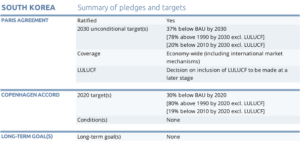
President Moon Jae-in pledged in October 2020 that Korea will reach carbon neutrality by 2050, joining a number of European countries and Japan. With China...
The Korean government is in the awkward position of attempting to prop up the economy through flagship corporations while holding them accountable.
The Moon Jae-in administration responds to the failure of existing policy to address public demand for more affordable housing.
The government responded to concerns around workplace safety, but produced an incomplete law because it did not engage workers who would be most affected.
Difficulties created by the prolonged pandemic creates tensions between shop owners and public health authorities.
The Korean government has not decided whether to protect private sector entities that employ the most workers or contribute to overall economic growth.
The government’s efforts to boost the childbirth rate fall short of the public’s desire for conditions that allow women to maximize their family planning choices.
The government’s new proposal to protect Small and Medium-sized Enterprises (SMEs) comes into conflict with property owners.