
Digital Campaigns and the Reach of South Korea’s Gender Ministry
Allocating a greater proportion of its budget to online advertising may position the ministry to better achieve its stated goals.
This essay was part of a contest jointly organized by the Institute for Korean Studies at George Washington University and the Institute for Korean Studies at Indiana University Bloomington. The contest invited students to analyze a South Korean policy challenge and propose evidence-based solutions. The winning essays are published on the Korea Economic Institute of America’s flagship blog, “The Peninsula.” The views expressed here are solely those of the author and do not reflect the views of KEI or its staff.
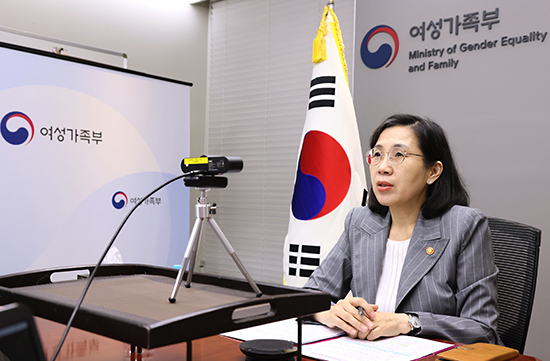
South Korea’s Ministry of Gender Equality and Family (MOGEF) devotes about 1 percent of its budget to media engagement, a share that limits its capacity to run the broad public campaigns that have shifted attitudes on gender in comparable countries. As the country confronts a widening divide between young men and women, much of it forming online, the ministry’s messaging tools have not kept pace with where that divide is taking shape. Reallocating a larger portion of its budget toward digital advertising would let MOGEF pursue the goals it has already set for itself and reach audiences that traditional outreach misses.
MOGEF was created in 1995 following a declaration at the Fourth World Conference on Women and was originally established as the Presidential Committee on Women’s Affairs before becoming the Ministry of Gender Equality. Today, MOGEF aims to support gender equality, victims of gender-related violence, and policies to address these issues.
While it applied for and has since received an increased budget for 2026, up 13 percent to KRW 2 trillion (USD 1.4 billion) year over year, it lags behind other ministries with overlapping responsibilities. For instance, the Ministry of Health and Welfare (MOHW), which shares responsibility for family and child policies and is often the recipient of tasks transferred from the MOGEF under conservative administrations, received a budget of KRW 137.5 trillion, almost seventy times the MOGEF’s budget. Part of that gap reflects MOHW’s broader mandate, including periods when family-related tasks have shifted between the two ministries.
MOGEF’s size and remit have long been the subject of political debate. The ministry’s own website shows that its portfolio has been reorganized several times across three decades, with functions added and removed under successive administrations. Former President Yoon Suk Yeol campaigned on abolishing the ministry, arguing that its approach to sex-crime policy risked treating men as presumptive offenders. Others, including the Reform Party’s Lee Jun-seok, have argued that MOGEF has largely completed its original mandate and that its remaining functions could be spread across the Korean government.
MOGEF’s current efforts and plans include a wide variety of tasks. Its current improvement plan includes strengthening existing functions, such as promoting women’s employment rates. In particular, MOGEF prioritizes expanding women’s participation in the policymaking process, increasing the number of female public officials in the public sector, and expanding women’s representation in leadership positions as major policy goals. However, the current budget limits the ministry’s ability to allocate funds across the many responsibilities under its jurisdiction.
Addressing Korea’s Gender Tensions
Korea’s gender divide has become one of its sharpest social fault lines, particularly among young people. President Lee Jae Myung addressed this in his inauguration speech, describing pressures that have led young men and women to “fight one another along gender lines.” Numerous studies highlight the growing political gap between young men and women in the country, driven by deepening misperceptions about gender equality (as young men are more likely to underestimate gender discrimination compared to their counterparts) and the prevalence of misinformation in male-dominated online spaces. This wedge manifests in widening divisions between young men and women on topics such as representation in corporate leadership and management roles and advocating for policies to reduce gender-based violence.
A divide shaped by online information and influence calls for messaging that is both wide-reaching and effective. Other countries, such as Australia and the United Kingdom, have faced similar challenges of rising gender-based tensions and have responded by increasing funds for advertisements. In Australia, the federal government worked with major social media networks to run an ad campaign called “Stop it at the Start,” a wide-reaching campaign that often interrupted prime-time programming to target parents, teachers, and other authority figures. The results were a 4.6 percent average improvement in sentiments and awareness of gender equality among children ages ten to seventeen, according to Australian advertising industry publisher B&T. Similarly, the United Kingdom’s campaign, “This is Abuse,” is a longer-running campaign focused on directly addressing teenagers from 2010 to 2014 and was used to address the fact that teenagers broadly did not understand finer details related to concepts such as consent and rape. The campaign led to an approximately 8–9 percent increase in public awareness—specifically related to recognizing, supporting victims, and challenging behavior among peers—among young men and women who had seen the advertisements. The United Kingdom has since continued similar efforts, such as the “Oi!” campaign.
Given Korea’s widespread internet culture, such advertisement campaigns are an effective means of supporting MOGEF’s mission. The average person in Korea spends 4.2 hours a day consuming media, including teens who, in online videos alone, average 3.3 hours, making advertisements particularly effective at appealing to large audiences. However, the costs of such campaigns pose challenges. Networks report that it can cost up to KRW 200 million (about USD 153,000) to run a fifteen-second commercial during major shows.
The Call for More
MOGEF’s 2026 budget allocates roughly KRW 2.1 billion, divided among major policy planning, publicity, and campaigns (KRW 968 million); online promotion (KRW 718 million); media-based policy promotion (KRW 336 million); and operational costs (KRW 38 million). Together, these amount to just 1 percent of the organization’s total operating costs.
Measured against the cost of airtime, that allocation buys little reach. If considering only online promotion, this would mean the ministry can only run three ads a year, and that budget must also stretch across the ministry’s youth and family mandates rather than gender equality alone. Sustaining a visible presence in traditional media on this basis is difficult, and even harder on platforms such as YouTube, where a majority of Koreans under thirty visit daily. On the evidence from campaigns abroad, a ministry seeking to shift public attitudes at scale would gain more from a larger and more concentrated investment in digital advertising.
Conclusion
MOGEF has set goals that reach beyond its current messaging capacity. Comparative experience suggests that well-designed advertising campaigns can measurably shift public understanding of gender equality and that digital channels are increasingly where Korea’s contested attitudes are formed. These goals aim to improve the quality of life for both men and women and may help improve societal tensions and obstacles facing gender equality in the country.
Benjamin Wampler is a student at Indiana University Bloomington. The views expressed here are solely those of the author and do not reflect the views of KEI or its staff.
This material is distributed by KEI on behalf of the Korea Institute for International Economic Policy. Additional information is available at the Department of Justice, Washington, DC.