
How the U.S.-South Korea Joint Fact Sheet Lays the Future of the Alliance
2026 will likely go down as an unusually significant test of the U.S.-South Korea alliance.
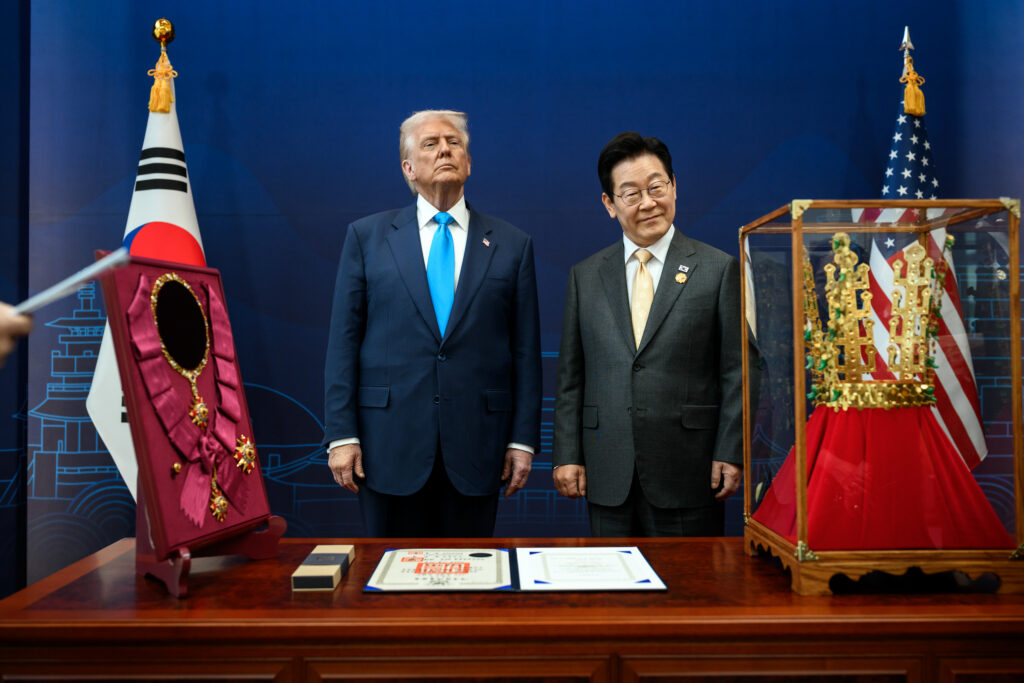
This issue of Korea Policy details recommendations for implementing the policy goals set forth in the U.S.-South Korea Joint Fact Sheet reaffirming the Korea Strategic Trade and Investment Deal approved at the summit between U.S. President Donald Trump and South Korean President Lee Jae Myung on October 29, 2025. There are two key sections: 1) new frontiers of cooperation between the two countries to include modernization of the security relationship, defense industrial cooperation, nuclear submarines, and cybersecurity; and 2) adapting the alliance amid global transformation on South Korea’s economic development strategy, civil nuclear cooperation, and AI export controls. For compelling reasons explained in the seven articles, the state of the alliance hinges on the successful implementation of these policy goals.
Why is 2026 likely to go down as an unusually significant test of the U.S.-South Korea alliance? At least four reasons deserve close attention. First, it is well-known that South Korea stands on the front line of an increasingly bipolar Northeast Asia, with tensions exacerbated since 2022 as international peace and stability are being shaken. The issues raised in this issue reflect this deteriorating environment. Second, technological change has come to the fore as never before since the advent of nuclear weapons. One article after another cites the urgency of responding to these challenges. Third, the Trump factor must not be overlooked, given his penchant for unilateral action and pressure. Authors do not shy away from mentioning it. Finally, South Korea has emerged as a vital powerhouse for U.S. security and economic transformation. Its critical role emerges repeatedly in the recommendations for alliance transformation for the sake of both states and of the world.
Modernizing U.S.-South Korea Alliance for New Strategic Frontiers
The four articles on new frontiers of cooperation highlight growing opportunities and risks for the U.S.-South Korea alliance. Reviewing past negotiations and agreements, they point to unfinished business and rapidly changing circumstances. Further delay would pose unprecedented risks.
Section One’s articles clarify South Korean thinking at this critical juncture in the alliance. Together, they identify new opportunities resulting from the Joint Fact Sheet and warn of accelerating risks if agenda items are not implemented. The first article calls for deepening U.S.-South Korea coordination on crisis-management mechanisms, political and diplomatic signaling, and China policy to modernize the alliance and contribute to a more sustainable deterrence posture. The second article argues that multi-domain, high-technology hybrid war demands a qualitative change in U.S.-South Korea defense industry cooperation. The third article explores how South Korea can strengthen its position when requesting the future development of more advanced nuclear-powered submarines (SSNs) by becoming a reliable U.S. partner in submarine maintenance, logistics support, infrastructure hosting, repair planning, and lifecycle services. The fourth article proposes a South Korean national cybersecurity strategy that aligns with U.S. priorities and serves as an anchor for alliance cooperation, reinforcing U.S. commitments to South Korea’s defense and leveraging both countries’ resources to strengthen private-sector investment in cybersecurity and foster cyber policy innovation.
In “The Path Forward for Alliance Modernization and Redesigning the U.S.-South Korea Alliance,” In Hyo Seol warns that despite talk of alliance modernization, neither government has articulated an official definition, implementation plan, or transition roadmap. It notes that the Iran war is acting as a powerful catalyst for accelerating changes to the alliance posture and force deployment in the Indo-Pacific, elevating the discourse on alliance restructuring from an abstract strategic discussion to a concrete, lived reality for expert communities and the broader publics of both nations. Yet, modernizing the alliance entails formidable challenges. Unlike past iterations of burden-sharing discussions, which implied a negotiated redistribution of costs within a broadly unchanged framework, the Trump administration’s new interpretation of burden-shifting entails a structural reallocation of responsibility. Allies are expected not merely to pay more but to assume fundamentally different roles—as primary defenders of their own territory, while the United States repositions itself as an enabler and backstop rather than a frontline protector.
The new division of labor portends changes to virtually every dimension of the combined defense posture. Successful modernization would serve as proof of concept for the broader U.S. global alliance restructuring strategy. Conversely, if South Korea—the most capable and best-prepared ally—fails to navigate modernization successfully, the signal sent to other U.S. allies would be deeply damaging. Failure to fundamentally update the alliance would be perilous, warns Seol.
Seol’s chapter addresses the need to respond to the systematic application of “America First” principles to alliance restructuring. Strategic flexibility demands a fundamentally different kind of alliance management—based on joint planning and institutional preparation rather than post-hoc diplomatic accommodation. Structural changes could lead to a narrative of retreat, as the public in both countries loses confidence in the alliance and leaders face pressure to hedge against its decline. Among the risks are the coercive negotiating style characteristic of the Trump administration, given that South Korean public opinion on the alliance—while broadly positive—is sensitive to perceptions of unequal treatment and can rapidly shift when the alliance appears to impose costs without corresponding benefits. Also at risk is the prospect that adjustments to United States Forces Korea (USFK) and its physical presence on the Korean Peninsula will be misread as a weakening of extended deterrence. To minimize such risks, Seol calls for expert-level consultations.
In “The Future of U.S.-South Korea Defense Industry Cooperation on AI and Cybersecurity,”Eunho Kang emphasizes that “multi-domain, high-technology hybrid war,” in which conventional warfare, cyber warfare, information warfare, electronic warfare, and space warfare unfold simultaneously on a single integrated battlespace, is now a concrete reality on the battlefield. North Korea is rapidly accumulating real combat experience with advanced technologies such as drones and electronic warfare. Meanwhile, South Korea faces internal demographic constraints, and externally, the United States is demanding not only increased defense burden-sharing but also voluntary contributions from its allies. Kang’s article offers recommendations for U.S.-South Korea cooperation in physical AI and cybersecurity—applying these domains to defense shipbuilding.
Multi-domain, high-technology hybrid warfare demands a fundamental shift in South Korea’s force buildup and a qualitative change in U.S.-South Korea defense industry cooperation. The allies need a model of cooperation that combines U.S. advanced AI design capabilities with South Korea’s world-class manufacturing base—and the two countries should apply this model to the defense shipbuilding sector. As land, sea, and air domains are integrated with space, cyber, and electronic warfare into a single battlespace, inferiority in any one domain translates into paralysis of the entire operation. The boundary between peacetime and wartime has collapsed. Hybrid warfare integrates conventional warfare, irregular warfare, cyber warfare, information warfare, and economic coercion. Warfare has become a war of attrition. In addition, software supply-chain contamination is a major threat, as is North Korea’s evolving conventional forces and real-world experience.
The alliance is being redefined as a structure in which each country maintains a certain level of independent deterrence and response capability and operates in a complementary manner, building an integrated command-and-control system that connects land, sea, and air weapon systems with space, sensors, and command communications. The South Korean armed forces should reorganize around unmanned systems by applying physical AI technology and enabling manned-unmanned teaming, autonomous operation, and robotic/AI pilots. South Korea’s role in enhancing U.S.-South Korea defense cooperation will thus become more important moving forward.
Kang highlights that the shipbuilding industry is the optimal showcase for the future of U.S.-South Korea defense cooperation—one that simultaneously demands collaboration in physical AI and cybersecurity. South Korea’s strengths make partnering with it an irreplaceable option in rebuilding the U.S. shipbuilding industry. Defense shipbuilding cooperation goes beyond simple industrial cooperation; it serves as a powerful model of security cooperation that embeds alliance trust in industry and technology. Successful cooperation in this sector is expected to rapidly spread to other areas, such as aviation and ground weapons.
In “Pathways to Cooperation for South Korea’s Successful Nuclear-Powered Submarine Acquisition,” Jihoon Yu identifies the legal, political, and technological barriers to South Korea’s successful acquisition of nuclear submarines. Failure in this endeavor, launched through Trump’s October 2025 approval, could deepen distrust in Washington, raise concerns regarding proliferation, and damage bilateral relations. Nonproliferation commitments, export control rules, alliance equity concerns, and the strain on the U.S. submarine-industrial base all weigh heavily on the issue. Yu recommends a phased strategy, grounded in a clear alliance-centered rationale, a legally sound, nonproliferation-centric framework, an industrial and human-capital compact that also benefits the United States, a gradual and transparent approach to sustainment and fuel cycle issues, and a broader diplomatic narrative that presents a South Korean SSN as a stabilizing and defensive contribution to regional maritime security. A disciplined approach will be far more credible than one that appears designed to maximize fuel cycle freedom. The more Seoul presents itself as the ally pursuing the most nonproliferation-compatible route, the easier it becomes to justify engagement.
Yu, however, worries that South Korea may not handle the SSN negotiations well, which could deepen mistrust in Washington, raise nonproliferation concerns, and leave U.S. officials with the impression that Seoul is asking for the most sensitive form of support before demonstrating the political discipline and institutional preparation such support would require. Thus, the most promising path is gradual, alliance-centered, and institutionally serious. Seoul should begin the process by demonstrating restraint, nonproliferation responsibility, industrial usefulness, workforce commitment, and diplomatic maturity. Yu urges South Korea to anchor the SSN debate in combined deterrence rather than prestige, maritime burden-sharing rather than autonomy theatrics, safeguards-compatible discipline rather than ambiguity, and long-term alliance trust rather than short-term political pressure. Succeeding in SSN acquisition will test the alliance, but successful implementation will expand alliance cooperation to a new frontier.
In “Enhancing Strategic Alignment in Cyberspace Within the U.S.-South Korea Alliance,” Sebastian Garciaobserves that cybersecurity requires constant adaptation and agility to remain ahead of the latest threat capabilities. Technological disruptions, including the emergence of AI, and new geopolitical developments, such as the strengthening of North Korea-Russia ties, only shorten time horizons. Garcia’sarticle proposes a South Korean national cybersecurity strategy that aligns with U.S. priorities, serving as a new anchor of alliance cooperation and stability, reinforcing credible U.S. commitments to South Korea’s defense, and leveraging both countries’ resources to strengthen private-sector investment in cybersecurity and foster cyber policy innovation. South Korea should work with the United States to seek alternative means of fostering shared interests between the public and private sectors without enacting stringent regulations that the United States will not countenance. This means formulating a new cybersecurity agenda to foster the development of a robust cyber insurance market, expand talent recruitment pipelines for the cyber policy and legal workforces, and deepen South Korea-Europe defense industrial partnerships in AI-enabled cyber capability research and development.
Central to the alliance’s defense posture in cyberspace is deterring the North Korean cyber threat, which has grown bolder and more sophisticated over the past decade. Its use of cyber operations as a tool of intelligence gathering and irregular warfare poses significant security threats. Garcia warns against moves that could undermine the U.S. strategic shift toward deregulation and recommends increasing public-private partnerships to maintain the U.S. technological advantage in cyberspace. The challenge is to demonstrate that South Korea is not a free rider in cyberspace but a proactive contributor to bolstering its own and other U.S. allies’ cyber capabilities. While divergent methods for shaping public-private cooperation and an increased U.S. demand for burden-sharing in cyber defense could be points of contention, this moment yields an opportunity for renewed alignment, including deterrence of a bolder, more sophisticated North Korean cyber threat.
Alliance Adaptation to an Era of Transformation
The common theme across Section Two’s articles is the application and impact of advanced technology, which present new opportunities for coordination. However, challenges include an unsustainable South Korean approach to economic development; shifts in U.S. political and commercial thinking on spent fuel recycling and implications for South Korea; and risk management for high-performance AI systems through infrastructure governance and joint export controls. The authors address these urgent needs with bold proposals.
In “South Korea’s New External Economic Development Strategy,”Taeho Bark and Dongchul Kwakwarn that given U.S. prioritization of domestic production over foreign investment and international trade, South Korea needs a new external economic development strategy. Bark and Kwak argue that the global trade environment has been uprooted; states are pursuing unilateral and discretionary industrial and trade policies aimed at maximizing or protecting national interests. Forced, along with others, to conclude agreements requiring large-scale investments in the United States, South Korea must recognize that expanded exports and high-standard free trade agreements (FTAs) are insufficient. The authors call for leveraging overseas foreign direct investment (FDI) to enhance domestic industrial competitiveness, expand exports, create jobs, and minimize the risks of industrial hollowing-out. Optimism rests on the fact that South Korean firms possess world-class manufacturing capabilities in advanced technologies and core industries and that its large firms already have strong global competitiveness.
Bark and Kwak propose three pillars of South Korea’s new external economic development strategy: 1) Expand exports linked to overseas investment by firms; 2) Lead in research and development (R&D) of advanced technology while continuously developing new technologies, attracting world-class foreign firms; and 3) Strengthen the international competitiveness of small and medium-sized enterprises (SMEs). In doing so, South Korea can overcome the challenges of the global trade environment and advance toward a more mature and resilient advanced economy.
For the first pillar, South Korea should transition from primarily producing final goods to becoming a global hub for exporting intermediate goods in advanced manufacturing, thereby supporting national strategic industries. Committed to investing USD 20 billion annually in the United States over the next decade, along with a USD 100 billion investment in U.S. shipbuilding, the South Korean government should consult closely with South Korean firms and communicate with the U.S. government to ensure these investments serve mutual interests.
For the second pillar, R&D should be clearly defined as enhancing capabilities to develop new technologies, manufacturing products based on those technologies, and assessing their commercial viability. Systems must ensure a seamless transition from laboratory research to pilot testing, initial production, and eventually, mass production. South Korea should establish R&D-manufacturing clusters in strategic industries and attract leading foreign firms to establish R&D bases domestically by offering world-class standards in research autonomy, compensation, long-term visa options, and family settlement.
The third pillar would capitalize on the relocation of foreign firms from China to ASEAN countries and India, while prioritizing the mitigation of barriers faced by South Korean SMEs, such as information gaps, financial constraints, and weak overseas networks. The government should provide structured education and training programs for SME employees covering macro-level changes in the global trade environment, geopolitical risks, the AI-driven technological transition, and supply-chain disruptions, as well as practical knowledge related to overseas markets, international contracts, negotiations, and local management. SMEs should stop viewing overseas investment and exports as high risk.
In “Rethinking the U.S.-South Korea 123 Agreement in a New Strategic Era,” Kayla Orta cites geopolitical shifts in the global civil nuclear market, changing regional security dynamics, rising global energy demand driven by AI, next-generation technologies, and the increased market shares of Chinese and Russian firms as central motivations for capitalizing on the momentum in the United States and South Korea for new nuclear energy policies. Together, the two allies should respond by updating and expanding their 2015 123 Agreement, the author proposes. Near-term opportunities should focus on 1) AI-driven nuclear industry revitalization, 2) traditional and advanced nuclear fuel supplies, and 3) spent fuel management and long-term storage strategies. Industry leaders should not be left out in the planning for a revised framework. For both Washington and Seoul, nuclear energy policy is gaining new momentum; engagement presents a critical opportunity to expand the presence of both countries in global markets while also reinforcing high standards for nuclear safety, security, and nonproliferation.
Orta’s article points to a rising sense of urgency in South Korea that the cooperation framework is not currently meeting its intended goals, and that the U.S.-South Korea civil nuclear relationship remains locked in a cycle of frustration. Points of national security interest—including nuclear fuel import dependencies and limitations in spent fuel waste storage—have strained U.S.-South Korea civil nuclear cooperation. The prolonged hiatus of the High-Level Bilateral Commission has remained a source of frustration for the South Korean government. Another source of concern is that Chinese and Russian state-backed firms have captured significant market shares through competitive financing and rapid-deployment nuclear export packages. The 123 framework needs to be quickly updated.
In “Redefining National Security Governance Through Access and Compute: U.S.-South Korea Export Controls on AI Infrastructure,” ChangHee Kim explores how the rules for AI chip exports are in flux. In March 2026, the U.S. Department of Commerce drafted rules that would require licenses for virtually all AI chip exports, potentially conditioning transfers of more than 200,000 chips on recipient countries agreeing to build AI data centers in the United States. In South Korea, the AI Basic Act entered into force on January 22, 2026, establishing risk-management obligations for high-performance AI systems, with phased enforcement beginning in 2027. The government also began distributing the first tranche of a ten-thousand-unit national graphics processing unit (GPU) pool in March 2026.
Parallel policy imperatives—U.S. efforts to maintain technological leadership and South Korea’s ambitions to secure AI infrastructure capacity—create both opportunities for alignment and governance gaps. Given that AI infrastructure is no longer transferred primarily through the movement of hardware, export control regimes need to move beyond a perspective centered on physical equipment and technical documentation and consider computation and access as core units of control. What is needed is coordination on new AI infrastructure governance, redefining AI data centers as “borderless strategic assets” controlled through access rights—an alliance‑based governance model built on compute quotas, Zero Trust, and real‑time access control systems.
In place of export control systems structured around the cross‑border movement of tangible items and technical documents, technology transfer in a borderless AI infrastructure environment is determined by who can access which compute resources and data, and with what entitlements. Specifically, Kim 1) shows that technology transfer in AI data centers is shifting from physical movement to access entitlement structures; 2) identifies a growing misalignment between data protection law, which has already codified access‑based transfer concepts, and export control law, which remains physical and act‑based; 3) proposes compute quota as a new policy control concept; and 4) links functional weaponization of AI directly to export and access control debates.
The center of gravity of national security risk is shifting from “What has moved?” to “Who can access which compute resources?” As AI data centers become more sophisticated, Kim argues that export control systems should be redesigned so that access entitlement structures, rather than physical borders, become the core unit of control. Compute quota—the combination of usage time, number of devices used in parallel, and intensity of workloads that yields functional capability—should become the object of control. U.S.-South Korea joint export control is emerging as a realistic alternative. This is not simply a matter of tightening existing rules, but of redesigning alliance‑based national security governance by introducing access and compute as new units of control.
Conclusion
In the spring of 2026, a whirlwind of diplomacy centered on China and Iran diverted attention from the U.S.-South Korea alliance. Chinese President Xi Jinping hosted President Trump and Russian President Vladimir Putin before traveling to Pyongyang for a summit with North Korean leader Kim Jong Un. Trump’s statements and posts took all the oxygen out of the room, leaving little room to focus on the alliance. Still, with little fanfare, the United States and South Korea continued exploring new frontiers of cooperation and adaptation for the alliance. The AI revolution accelerated these discussions, especially as its application to warfare, as seen in Ukraine and Iran, grew more compelling.
For the issues raised in this volume, a series of questions come to the forefront. 1) Would the “constructive strategic stability” Trump and Xi touted at their summit impact U.S. policy toward South Korea? 2) Would Xi’s closer embrace of Kim reverberate in actions that would impact the U.S.-South Korea alliance? 3) Would the way the Iran war appeared to end with a memorandum of understanding affect Trump’s foreign policy agenda? and 4) Would the United States pivot back to alliance-building in East Asia at a time when its alliance system was suffering unprecedented disruption? Answers are unlikely to come before the new rounds of diplomacy planned for the fall of 2026. Uncertainty clouds the initiatives discussed in what follows.